
In brief: Peripheral artery disease is narrowing of the leg arteries due to atherosclerosis. The typical sign is calf pain on walking that eases with rest (claudication). In advanced disease, opening the blocked artery in time can save the limb.
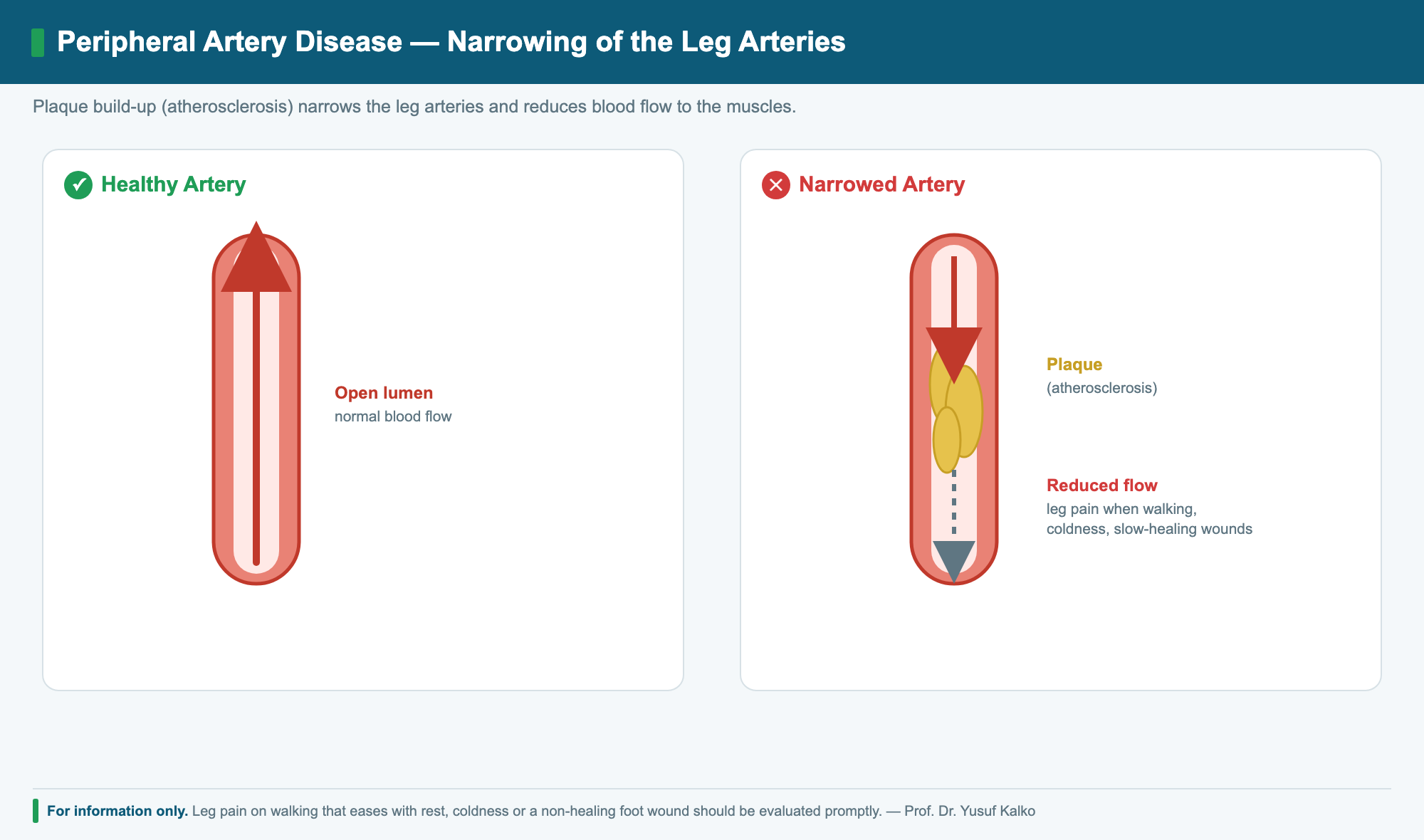
What Is Peripheral Artery Disease?
When the leg arteries narrow, the muscles do not receive enough blood. Early on this causes claudication; later, rest pain, coldness, colour change and non-healing wounds may appear. Smoking, diabetes, high blood pressure and high cholesterol are the main risk factors.
Diagnosis and Treatment
Diagnosis uses examination, the ankle-brachial index (ABI) and Doppler ultrasound. Treatment includes lifestyle changes and medication, and when needed balloon/stent (angioplasty), bypass, or closed/hybrid methods such as minimally invasive vascular procedures.
Limb Salvage
In severe blockages threatening the limb, restoring blood flow (revascularisation) is decisive. Many patients can avoid amputation when the artery is opened in time; this is also central to diabetic foot care.
Symptoms of Peripheral Artery Disease
- Cramping pain in the calf, thigh or buttock that starts on walking and eases with rest (claudication)
- A walking distance that becomes progressively shorter
- Coldness, paleness or colour change in the foot and leg
- Weak or absent pulses in the foot
- In advanced disease, pain even at rest, non-healing wounds or tissue loss
Warning — critical limb ischaemia: Leg or foot pain that continues at rest, darkening of the foot or a wound that will not heal may be a sign of advanced blockage (critical limb ischaemia) and can threaten the limb. In this situation a cardiovascular surgeon should be seen without delay. Sudden, severe pain together with coldness and colour change in one leg may indicate an acute blockage (embolism) and is a medical emergency.
Causes and Risk Factors
Peripheral artery disease develops when plaque builds up in the artery wall (atherosclerosis) and narrows the vessels carrying blood to the legs. The most common contributing factors are:
- Smoking — one of the most significant risk factors
- Diabetes — see Diabetic Foot
- High blood pressure and high cholesterol
- A sedentary lifestyle and excess weight
- Older age; in Buerger’s disease, artery blockage is closely linked to tobacco use
Treatment Options
Treatment is planned according to the location of the blockage, how widespread it is, the stage of disease and the patient’s overall condition.
1. Lifestyle and Medical Treatment
Stopping smoking is essential. Regular walking exercise, control of blood pressure, cholesterol and blood sugar, and medication chosen by the physician (for example blood-thinning or cholesterol-lowering drugs) form the basis of care in the early stages.
2. Closed (Endovascular) Method — Balloon and Stent
A catheter is guided to the blockage, the artery is widened with a balloon and, where needed, a stent is placed. This can be performed through a small puncture and may be suitable for shorter, localised narrowings.
3. Open Surgery — Bypass / Endarterectomy
The blocked segment is bypassed by creating a new route for blood flow, or the plaque is removed from the artery. This is considered for long or widespread blockages.
4. Hybrid Method and Limb Salvage
In complex, multi-level blockages, open and closed techniques may be combined in the same session (a hybrid approach). When the blockage can be reopened appropriately, limb salvage can be considered in many patients, even in legs that may appear difficult to treat. Which method is suitable depends on the individual and is decided by the physician.
When Is a Procedure or Surgery Needed?
Medication, stopping smoking and a regular walking programme are the first step. An endovascular procedure (balloon/stent) or surgery (bypass) is considered in situations such as:
- Leg pain (claudication) that seriously limits walking and reduces quality of life
- Pain that continues even at rest
- Non-healing wounds or tissue loss (critical limb ischaemia)
- Advanced, multi-level blockages
Recovery and Aftercare
With the closed (balloon/stent) method, recovery is usually quick, with a short hospital stay and a return to daily life within a few days. After bypass surgery, the hospital stay and recovery are somewhat longer. In both cases, regular follow-up and ongoing control of risk factors are important for a lasting result.
The Role of the Hybrid Approach
Blockages in the leg arteries are not always confined to a single level; different types of narrowing may occur together in the same leg, for example at the groin and below the knee. In these multi-level and complex cases, a hybrid approach that combines open surgery (bypass or plaque removal) with closed endovascular techniques (balloon/stent) in the same session can offer a comprehensive solution and, in suitable cases, support limb salvage.
Frequently Asked Questions
Can the leg be saved without amputation?
In many cases, yes. When the blocked artery is opened in time (balloon/stent, bypass or hybrid methods), blood flow is restored and the limb can often be saved.
What is the typical symptom?
Calf pain that starts on walking and eases with rest (claudication); in advanced disease, rest pain and non-healing wounds.
How is it diagnosed?
By examination, ankle-brachial index (ABI) and Doppler ultrasound.
Is this medical advice?
No. This page is for information only; please consult a physician for diagnosis and treatment.
How is leg artery blockage surgery performed?
Depending on the location and severity of the blockage, the artery is reopened either with a closed method (catheter balloon/stent) or with open surgery (bypass, plaque removal). The suitable method is chosen after Doppler ultrasound and angiography.
Is a stent or a bypass preferred?
Shorter, localised narrowings are often treated with the closed balloon/stent method, while long or multi-level blockages may favour bypass. The decision depends on the patient’s vascular anatomy and overall condition.
What is a hybrid procedure?
It is an approach in which open surgery and closed (catheter-based) techniques are used together in the same session, which can be an advantage in complex, multi-level blockages.
What is the ankle-brachial index (ABI)?
It is a simple, painless test that compares the blood pressure at the ankle with that in the arm, used to assess leg artery blockage.
What is critical limb ischaemia?
It is an advanced stage with pain even at rest, non-healing wounds or darkening of the foot, carrying a risk of limb loss; it needs urgent assessment.
Is walking exercise helpful?
Yes. A regular, structured walking programme can help improve walking distance in the early stages.
Which symptoms need emergency attention?
A leg that suddenly becomes cold, pale, painful and numb (acute blockage) is an emergency and requires immediate medical care.
Video — Prof. Dr. Yusuf Kalko
Prof. Dr. Yusuf Kalko explains the hybrid (open + closed) approach in blocked-artery treatment. (Video in Turkish.)
Related
Diabetic Foot · Buerger’s Disease · Minimally Invasive Vascular Surgery
This content is for information purposes only and does not replace a medical consultation. Diagnosis and treatment require an in-person examination. — Cardiovascular Surgeon Prof. Dr. Yusuf Kalko