
In brief: Many vascular blockages can be treated with closed (catheter-based) and hybrid techniques — through a small groin access, often under local anaesthesia, with faster recovery. In advanced disease these methods can help save the limb without large open surgery.
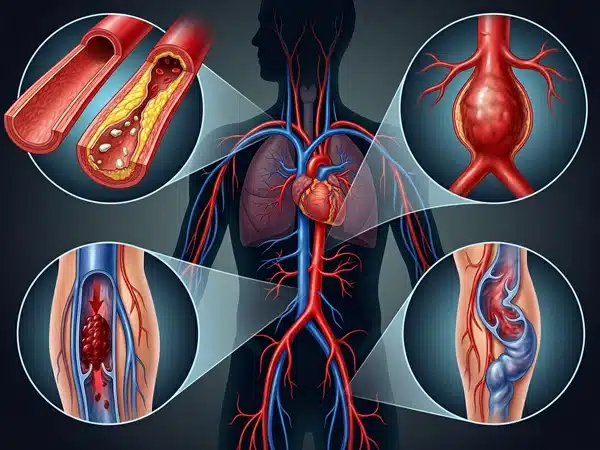
Closed (Catheter-Based) Methods
Through a needle-sized groin access, the blocked artery is reached under imaging guidance and reopened with balloon angioplasty and, when needed, a stent. Mechanical atherectomy can remove (rather than just push aside) hard plaque and clot from inside the vessel.
Hybrid Procedures (Open + Closed Together)
In complex blockages, open and closed techniques are combined in a single procedure (hybrid). This allows treating long or multi-level disease that one method alone cannot fully address, while keeping the intervention as limited as possible.
Limb Salvage
When a leg is threatened by severe blockage (in peripheral artery disease, diabetic foot or Buerger’s disease), restoring blood flow in time can prevent amputation. Suitability is decided after imaging and examination.
Who Is Suitable?
Not every blockage is suitable for closed methods; very long, heavily calcified or widespread disease may need open or hybrid approaches. The plan is individual and determined by the vascular surgeon.
What Is Minimally Invasive Vascular Surgery?
Traditional open surgery usually requires large incisions and general anaesthesia. In minimally invasive (closed) vascular surgery the same problem is treated through very small accesses — often just a needle puncture or a tiny incision — and frequently under local anaesthesia. These techniques can be used for blockages in the arteries of the heart, legs and neck (carotid artery). Treated in time, they may help prevent serious consequences such as heart attack, stroke and gangrene. The aim is to reduce the strain placed on the body without compromising the effectiveness of treatment.
Which Vascular Conditions Is It Used For?
- Varicose veins and venous insufficiency (laser/radiofrequency ablation, foam, vein-sealing)
- Leg artery blockage (balloon/stent, atherectomy)
- Aortic aneurysm (closed method — EVAR; also mini-laparotomy approaches)
- Selected carotid artery conditions
The Advantage of Local Anaesthesia
Because many minimally invasive procedures can be performed under local anaesthesia, the patient can remain awake. This may help assess the result during the procedure and reduces the risks associated with general anaesthesia. Among the published work of Prof. Dr. Yusuf Kalko are less invasive approaches such as performing carotid surgery under local anaesthesia and using mini-laparotomy in abdominal aortic surgery.
How It Differs From Open Surgery — and Its Advantages
- Small incision or needle puncture; less tissue damage
- Generally less pain and a faster recovery
- Usually a short hospital stay
- Reduced general-anaesthesia risk (when local anaesthesia is used)
- Often a more favourable cosmetic result
Which Patients Benefit Most?
- People with high blood pressure, diabetes or kidney disease
- People with respiratory problems such as chronic bronchitis or COPD
- Older patients who carry a high anaesthesia risk
- Situations in which open surgery would be risky
Is It Always the Right Choice? (Limits)
A minimally invasive method is not “always better” — it is the option preferred when it is suitable. For very widespread, long-segment or complex blockages, open surgery or a hybrid approach may be more appropriate. Whether the method fits depends on the patient, the location of the blockage and the overall state of health, and is determined by the physician.
Recovery Process
Thanks to the small accesses, many patients are able to get up and return to daily life within a short time, and the hospital stay is usually brief. Recovery time varies with the procedure and the individual patient. The medicines recommended afterwards and regular follow-up checks remain important, and results differ from person to person.
Frequently Asked Questions
Can blocked leg arteries be opened without open surgery?
In many cases, yes — through closed (catheter-based) methods such as balloon/stent and mechanical atherectomy, often under local anaesthesia.
What is a hybrid procedure?
A combination of open and closed techniques in one procedure, used for complex or multi-level blockages.
Can these methods prevent amputation?
When blood flow is restored in time, limb salvage is often possible; outcomes depend on the severity and timing.
Is this medical advice?
No. This page is for information only; please consult a physician for diagnosis and treatment.
What is minimally invasive vascular surgery?
It is a vascular surgery approach performed through small incisions and frequently under local anaesthesia, making it less invasive than open surgery.
Who is it suitable for?
It can be advantageous especially for patients in whom general anaesthesia is risky (high blood pressure, diabetes, kidney disease, COPD, advanced age). Suitability is assessed by the surgeon.
Why is local anaesthesia preferred?
Because the patient can remain awake, it may help assess the result during the procedure and reduces general-anaesthesia risk.
What are the advantages of minimally invasive surgery?
Small incision or needle puncture, less pain, faster recovery, a short hospital stay and generally a more favourable cosmetic result.
Is minimally invasive surgery always superior to open surgery?
No. It is preferred when appropriate; in some situations open surgery may be more suitable. The decision is individual.
How long does recovery take?
It varies with the method, but for many procedures the return to daily life is faster than after open surgery.
Will there be a scar after the procedure?
Because the incisions are small, any marks are usually faint, and some closed procedures leave no noticeable mark.
Can it be performed in older or higher-risk patients?
For higher-risk patients who are not suitable for open surgery, minimally invasive methods can be an important option; the decision is individual.
Video — Prof. Dr. Yusuf Kalko
Prof. Dr. Yusuf Kalko explains the hybrid (open + closed) vascular approach. (Video in Turkish.)
Related
Peripheral Artery Disease · Diabetic Foot · Buerger’s Disease
This content is for information purposes only and does not replace a medical consultation. — Cardiovascular Surgeon Prof. Dr. Yusuf Kalko