In brief: Varicose veins develop when one-way valves in the leg veins fail and blood pools (venous reflux). Diagnosis is made with a clinical exam and colour Doppler ultrasound; treatment is mostly minimally invasive — laser (EVLA), radiofrequency or foam sclerotherapy. Prof. Dr. Yusuf Kalko provides this treatment in Turkey (Istanbul) and welcomes international and Gulf patients.

What Are Varicose Veins?
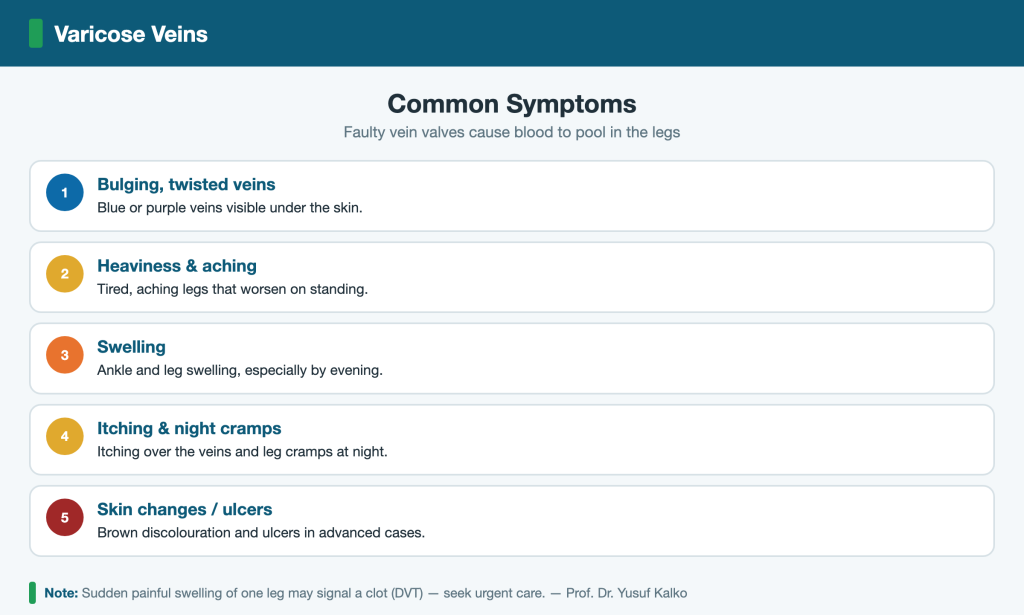
Varicose veins are enlarged, twisted superficial veins, usually in the legs, caused by failure of the venous valves. The underlying problem is often chronic venous insufficiency. Symptoms include heaviness, aching, swelling that worsens by evening, cramps and visible veins.
How Are Varicose Veins Treated?
The right method depends on the vein diameter and the location/degree of reflux, determined by Doppler ultrasound:
- Endovenous laser (EVLA) and radiofrequency ablation — close the faulty main vein from the inside using heat; usually under local/tumescent anaesthesia
- Foam sclerotherapy — for fine and spider veins, the vein is closed with an injected foam medication
- Compression stockings — relieve symptoms in early stages and after treatment
- Surgery is reserved for selected advanced cases
Most patients return to daily activities the same day; recovery after closed methods is generally quick.
When to See a Doctor
Increasing heaviness, swelling, skin colour changes or a non-healing leg ulcer should be evaluated by a cardiovascular surgeon. Sudden one-sided swelling and pain may indicate a clot and require urgent attention.
Types of Varicose Veins
Varicose veins are not a single condition; they vary by the size and depth of the affected vein, and the treatment approach changes accordingly:
- Spider veins (telangiectasia): thin red-purple veins close to the skin surface; usually a cosmetic concern.
- Reticular veins: slightly larger than spider veins, appearing blue-green beneath the skin.
- Truncal (saphenous) varicose veins: bulging, rope-like, prominent veins; these are usually linked to underlying venous insufficiency and need medical treatment.
Symptoms of Varicose Veins
- Aching, heaviness and tiredness in the legs
- Visible, enlarged and twisted veins
- Swelling around the ankle and calf
- Night-time leg cramps
- Itching and skin colour changes
- Non-healing wounds in advanced stages
Stages of Varicose Veins: The CEAP Classification
Physicians grade the severity of venous disease using the international CEAP system. The clinical (C) stages help guide the treatment plan:
- C0: No visible or palpable signs of venous disease
- C1: Spider (telangiectasia) or reticular veins
- C2: Prominent varicose veins (usually 3 mm or larger)
- C3: Leg oedema (swelling)
- C4: Skin colour changes, eczema or hardening
- C5: A healed (closed) venous ulcer scar
- C6: An active venous ulcer (open wound)
Advanced stages (C4–C6) are situations in which treatment should not be delayed.
How Varicose Veins Are Diagnosed
The key tool in assessing varicose veins is colour Doppler ultrasound. The scan is usually performed while the patient is standing, because valve leakage (reflux) is assessed more accurately upright, under the effect of gravity.
- Examination
The symptoms are reviewed and the legs are inspected. - Colour Doppler ultrasound
The vein valves and the direction of blood flow (reflux) are imaged. - Treatment plan
The most suitable method is decided together, based on the patient’s condition.
Treatment Methods in Detail
Treatment is planned individually according to the type of varicose vein and the degree of venous insufficiency. The main options are:
Lifestyle Measures and Compression Stockings
In early stages and to support treatment, regular walking, elevating the legs, weight control and compression (medical) stockings at the pressure advised by your doctor can ease symptoms and help slow progression.
Endovenous Laser and Radiofrequency (Thermal Ablation)
A thin catheter is guided into the faulty vein under ultrasound, and the vein is closed from the inside using laser (EVLA) or radiofrequency (RFA) energy. These are among the main methods used today and are mostly carried out under local anaesthesia.
Foam Sclerotherapy
A foam-form medication is injected into the vein, causing it to shrink and close. It is used for medium-sized varicose veins and for fine spider veins.
Vein Glue (Medical Adhesive)
This is a heat-free method in which the vein is sealed with a special medical adhesive; it may be considered in suitable cases.
Comparison of Treatment Methods
| Method | Anaesthesia | Recovery / return to work | Best suited for |
|---|---|---|---|
| Laser (EVLA) | Local/tumescent | Often the same day | Truncal (saphenous) reflux |
| Radiofrequency (RF) | Local/tumescent | Often the same day | Truncal reflux |
| Vein glue (VenaSeal) | Local | Fast; may not require stockings | Suitable anatomy |
| Foam sclerotherapy | None/local | Fast | Spider to medium veins |
| Mini-phlebectomy | Local | A few days | Prominent bulging veins |
| Classic surgery (stripping) | General/spinal | Longer | Selected advanced cases |
The Procedure: How It Is Done and How Long It Takes
Today most varicose vein treatment is performed with minimally invasive (non-surgical) methods. With laser or radiofrequency, a thin catheter is placed into the vein under ultrasound guidance and, after tumescent anaesthesia, the vein is closed from the inside. The procedure usually takes 30–60 minutes, and patients are most often discharged the same day.
Thanks to local anaesthesia, discomfort during the procedure is kept to a minimum, and most patients return to their daily routine quickly. Classic surgery (stripping) is reserved for selected advanced cases, performed under general or spinal anaesthesia, and recovery can take longer.
After Treatment: What to Expect
After minimally invasive methods most patients can walk the same day and generally return to daily life within a short time. Compression stockings may be recommended for a period; regular walking and avoiding long periods of sitting still support recovery. The recovery time and follow-up visits vary from person to person and are determined by your physician.
Why Choose Turkey (Istanbul) for Your Treatment?
- Over 30 years of experience in cardiovascular and vascular surgery.
- Advanced minimally invasive and hybrid techniques.
- English- and Arabic-speaking support for international and Gulf patients.
- Competitive costs and easy access to Istanbul from the Gulf, Europe and beyond.
- Pre-travel remote assessment, then treatment and appointment planning.
How to Start from Abroad (Remote Consultation)
You can send your medical reports and scan images via WhatsApp for an initial assessment before traveling. We then plan your treatment and appointment in Istanbul, Turkey, and support international patients at every step.
📋 This page is part of our Vascular Diseases guide. See the overview for other vascular conditions, symptoms and treatments in Turkey (Istanbul).
Frequently Asked Questions
How are varicose veins treated?
After examination and Doppler ultrasound, a suitable method (laser/EVLA, radiofrequency or foam sclerotherapy) is applied, mostly under local anaesthesia; the faulty vein is closed and blood is redirected to healthy veins.
Is the treatment painful?
Minimally invasive methods are usually performed under local anaesthesia and are generally well tolerated; mild bruising afterwards resolves quickly.
Can varicose veins be treated without surgery?
Yes. Laser (EVLA), radiofrequency and foam sclerotherapy treat varicose veins without open surgery; suitability is determined by Doppler.
Can varicose veins come back?
If risk factors persist, new varicose veins may develop in other veins; regular follow-up reduces this risk.
Is this medical advice?
No. This page is for information only; please consult a physician for diagnosis and treatment.
How long does varicose vein treatment take?
With minimally invasive (laser/RF) methods the procedure usually takes 30–60 minutes, and patients are most often discharged the same day. The duration depends on how widespread the varicose veins are and the method chosen.
What are the types of varicose veins?
There are three main types: spider (telangiectasia) veins, reticular veins and truncal (main saphenous) varicose veins. The treatment approach varies by type.
What is the CEAP classification?
CEAP is an international system that clinically grades the severity of venous disease from C0 to C6; it helps guide the treatment plan.
Which treatment method is right for me?
The method is chosen individually based on the type, diameter and extent of the varicose veins and the colour Doppler findings. There is no single method that suits everyone.
Is anaesthesia needed for varicose vein treatment?
Many minimally invasive methods can be performed under local anaesthesia; the type of anaesthesia is decided by the physician according to the method and the patient.
Do I need to wear compression stockings after treatment?
Compression stockings are often recommended for a period after most procedures; your physician will decide how long to use them.
Can varicose veins be treated during pregnancy?
During pregnancy, compression stockings and lifestyle measures are usually recommended, and interventional treatments are mostly left until after delivery. The decision is made by your physician.
Do untreated varicose veins get worse?
With progressing venous insufficiency, leg swelling, skin changes and, in advanced stages, a non-healing venous ulcer can develop, which is why evaluation is important.
Do you treat international patients?
Yes. We welcome international and Gulf patients in Turkey (Istanbul), with English- and Arabic-speaking support throughout assessment and treatment.
How can I book an appointment from abroad?
Via WhatsApp: send your inquiry and medical reports, and we will arrange your appointment and explain the steps before and after arriving in Istanbul.
How much does treatment cost?
Cost depends on your condition and the treatment plan. For an estimate, contact us via WhatsApp with your medical reports attached.
Can I have a consultation before traveling?
Yes. An initial remote assessment can be made based on your reports and scans before you come to Turkey.
Video — Prof. Dr. Yusuf Kalko
Prof. Dr. Yusuf Kalko explains what varicose veins are and how they are treated. (Video in Turkish.)
Related
Minimally Invasive Vascular Surgery · Peripheral Artery Disease · About Prof. Dr. Yusuf Kalko
This content is for information purposes only and does not replace a medical consultation. Diagnosis and treatment require an in-person examination. — Cardiovascular Surgeon Prof. Dr. Yusuf Kalko