
In short: Cramping leg pain that starts when you walk and eases when you rest — always at a similar distance — is called intermittent claudication and is a classic warning sign of peripheral artery disease (PAD): narrowing of the leg arteries by atherosclerosis. Not every leg pain is arterial — vein problems, nerve (sciatica) and muscle strain feel different. Warning signs that need prompt attention include pain at rest, a non-healing wound, or a sudden cold, pale, painful leg (an emergency). Diagnosis is simple and painless (ankle-brachial index, Doppler ultrasound); treatment ranges from stopping smoking and a walking programme to angioplasty/stent or bypass. PAD is also a marker of heart-attack and stroke risk. This guide is written for international patients considering assessment in Istanbul, Turkey.
If you are weighing up whether your own symptoms fit this pattern, the leg circulation self-check runs through the same nine features in about a minute.
What Is Claudication?
When leg arteries narrow, working muscles cannot get enough blood during exercise. The result is a cramping, aching or tired feeling — usually in the calf, but sometimes the thigh or buttock — that appears after walking a certain distance and disappears within minutes of resting. As the narrowing progresses, the walking distance before pain gets shorter. This pattern is the hallmark of peripheral artery disease.
Is It Your Arteries, Veins, Nerves or Muscles?
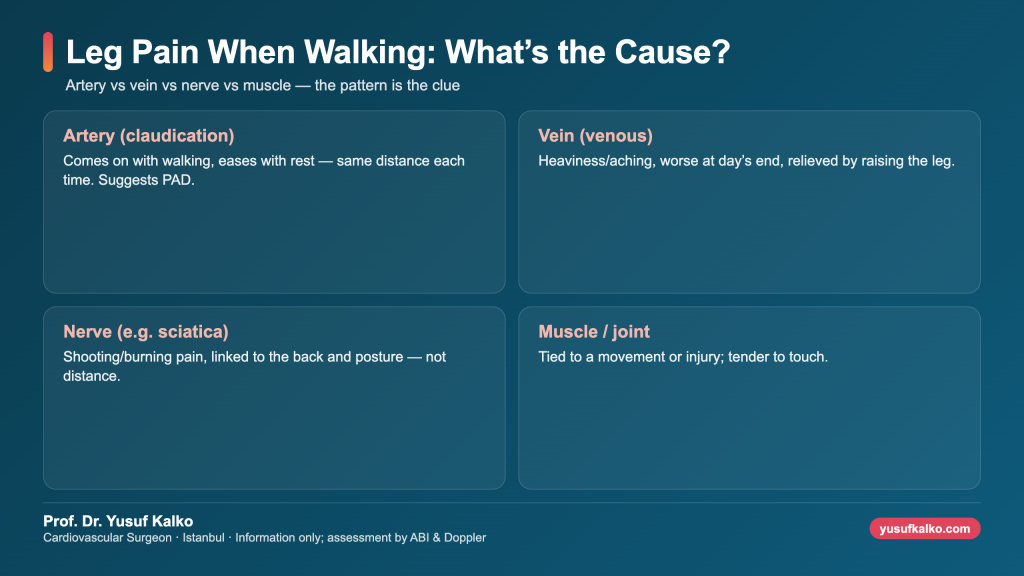
Leg pain has several causes that are treated very differently. The pattern helps tell them apart:
| Cause | Typical pattern |
|---|---|
| Artery (claudication) | Comes on with walking, eases with rest, similar distance each time |
| Vein (venous) | Heaviness/aching worse at end of day, relieved by elevating the leg |
| Nerve (e.g. sciatica) | Shooting/burning pain, linked to back and posture, not walking distance |
| Muscle/joint | Related to a specific movement or injury, tender to touch |
Warning Signs You Should Not Ignore
- Pain at rest, especially in the foot at night, eased by hanging the leg down,
- A wound or ulcer that will not heal, or blackening of a toe (gangrene),
- The foot feeling cold, pale or numb,
- Rapidly shortening walking distance.
Emergency: Acute Limb Ischaemia
⚠️ A suddenly cold, pale, painful and weak leg can mean an artery has blocked acutely. This is an emergency and can threaten the limb within hours. Do not wait — seek urgent medical care.
How Peripheral Artery Disease Is Diagnosed
Assessment starts with examination and pulses, plus a simple, painless ankle-brachial index (ABI) — comparing blood pressure at the ankle and arm. Colour Doppler ultrasound shows where and how severe the narrowing is, and CT or MR angiography maps the arteries when a procedure is planned.
Treatment Options
- Risk control: stopping smoking is the single most important step; managing blood pressure, cholesterol and diabetes,
- Supervised walking programme and medication as advised,
- Angioplasty and stent (a closed, catheter procedure) to open the narrowed segment,
- Bypass surgery for long or complex blockages,
- In advanced cases, a limb-salvage approach to avoid or reduce amputation.
It Is Not Just Your Legs: Heart and Stroke Risk
Peripheral artery disease is a sign of widespread atherosclerosis. Someone with significant leg-artery narrowing is also more likely to have disease in the heart’s arteries and the carotid arteries that supply the brain. So treating PAD is also about lowering the risk of heart attack and stroke — through the same steps of stopping smoking and controlling cholesterol, blood pressure and diabetes.
For International Patients (Istanbul)
International patients are assessed by an experienced cardiovascular surgeon in Istanbul with a clear, step-by-step pathway:
- Remote consultation: share your symptoms and any reports via WhatsApp for a preliminary opinion.
- On arrival: examination, ABI and Doppler ultrasound; angiography if a procedure is planned.
- Treatment: from risk control and a walking programme to angioplasty/stent or bypass, tailored to your arteries.
- Follow-up: aftercare, medication guidance and advice on safe travel.
Prof. Dr. Yusuf Kalko, Cardiovascular Surgeon in Istanbul (Beylikdüzü), evaluates leg circulation as part of your overall vascular health. Reach the clinic via the contact page.
Frequently Asked Questions
What does claudication feel like?
Usually a cramping, aching or tired feeling in the calf (sometimes thigh or buttock) that comes on after walking a certain distance and eases within minutes of resting. It tends to occur at a similar distance each time.
How do I know if my leg pain is arterial or venous?
Arterial (claudication) pain comes with walking and eases with rest; venous pain is more a heaviness that worsens through the day and improves when the leg is raised. A Doppler ultrasound settles the question.
Is peripheral artery disease dangerous?
It can be. Beyond leg symptoms, it signals a higher risk of heart attack and stroke, and advanced disease can threaten the limb. The good news is that much of the risk is modifiable.
What is the ankle-brachial index (ABI)?
A simple, painless test comparing blood pressure at the ankle and the arm. It gives a quick indication of whether the leg arteries are narrowed and helps guide further tests.
Can PAD be treated without surgery?
Often yes, especially early on: stopping smoking, a walking programme and medication can improve symptoms. When needed, angioplasty and stent are closed (non-surgical) procedures; bypass is reserved for complex cases.
Why does stopping smoking matter so much?
Smoking is the strongest modifiable risk factor for peripheral artery disease. Quitting slows progression, improves walking distance and lowers the risk of heart attack, stroke and limb loss.
When is leg pain an emergency?
A suddenly cold, pale, painful, numb or weak leg can indicate an acute arterial blockage and needs urgent care. A non-healing wound or blackening toe also needs prompt attention.
How do I start an assessment from abroad?
Send your symptoms and any medical reports via WhatsApp for a preliminary opinion, then plan an in-person examination, ABI and Doppler ultrasound on arrival in Istanbul.
References
- NHS — Peripheral Arterial Disease (PAD)
- MedlinePlus (NIH) — Peripheral Arterial Disease
- Society for Vascular Surgery
