
Leg pain on walking is common and most of it is not arterial. But one pattern is, and it is worth recognising because it is the early, treatable stage of a condition that ends in tissue loss if it is left alone. This page sets out that pattern, gives a short self-check, and explains the painless test that settles the question.
In short: cramping calf pain that begins after a fairly predictable walking distance and stops when you stand still is the characteristic symptom of peripheral artery disease. Two findings change the urgency entirely — pain in the foot at rest and a wound that will not heal. Diagnosis is an ankle pressure measurement plus a Doppler ultrasound, neither of which hurts.
Leg circulation self-check
Nine questions, roughly a minute. Nothing you enter is stored or sent anywhere — the whole thing runs in your browser.
The score is a prompt to get checked, not a measurement of your circulation. Two answers override the score entirely, and the tool says so when they apply.
What the test is looking for
Peripheral artery disease is narrowing of the arteries that carry blood to the legs, almost always from atherosclerosis — the same process that narrows the heart and neck arteries. It builds over years without symptoms, because the leg copes at rest on very little. Symptoms appear when demand rises, which is why walking is what exposes it.
That matters beyond the leg. Narrowing in the leg arteries is a marker of the same disease elsewhere, so finding it changes the assessment of carotid and cardiac risk too. In that sense a positive result here is useful information rather than simply bad news.
Claudication: the symptom that identifies it
What it feels like
Claudication is a cramping, aching or tight sensation — usually in the calf, sometimes the thigh or buttock — that comes on during walking. Three features make it recognisable:
- It starts after a fairly consistent distance — the same street corner, the same flight of stairs.
- It gets worse walking uphill or hurrying, because demand rises faster.
- It is relieved by standing still, within a few minutes, and you do not need to sit or bend forward.
What it is often confused with
Spinal claudication, from narrowing of the spinal canal, also produces leg pain on walking — but it is relieved by sitting or leaning forward rather than by standing still, and the distance varies from day to day. Venous heaviness, by contrast, builds through the day after standing and eases when the legs are raised. The distinction is set out below, and it matters because the treatments share nothing.
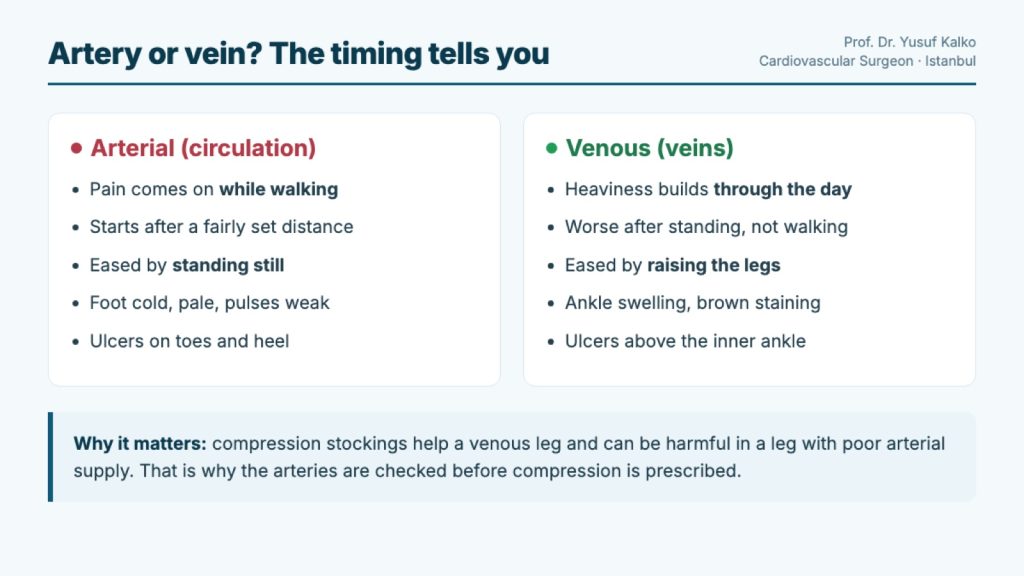
| Arterial (claudication) | Spinal (neurogenic) | Venous | |
|---|---|---|---|
| When it starts | While walking, after a set distance | While walking or standing, distance varies | Builds through the day |
| What relieves it | Standing still, a few minutes | Sitting or leaning forward | Raising the legs |
| Downhill or uphill | Worse uphill | Often worse downhill | No clear pattern |
| Foot pulses | Weak or absent | Normal | Normal |
| Skin | Pale, cool, shiny, hair loss | Normal | Brown staining, eczema above the ankle |
| Where ulcers form | Toes, heel, pressure points | None | Above the inner ankle |
The two answers that change everything
Claudication limits what you can do; it does not threaten the leg. Two findings do, and they define what is called chronic limb-threatening ischaemia:
- Pain in the foot or toes at rest, typically worse at night, relieved by hanging the leg out of bed or sleeping in a chair. Gravity is doing what the arteries can no longer manage.
- A wound, ulcer or blackened area that is not healing — however small it looked when it started.
At this stage the tissue is surviving on a margin that has run out. It is still the stage at which a limb is usually saved, but the window is measured in weeks rather than months, and the sequence matters: blood flow is restored first, and only then is dead tissue removed. That is explained under gangrene and limb salvage, and where someone has been told a vessel cannot be opened, under second opinion and limb salvage.
Go to an emergency department now if a leg becomes suddenly cold, pale, numb and severely painful, with no pulse in the foot. This can mean an artery has blocked abruptly, and there is only a short window in which it can be reopened. Also seek same-day care for a spreading black or discoloured area, for a foot wound with fever or foul discharge, and for rest pain that has become constant.
A particular warning in diabetes
Diabetes alters the presentation in two ways that both delay diagnosis. Nerve damage can remove the pain, so claudication never appears and the first sign is a wound found by looking rather than felt. And the ankle pressure measurement can read falsely high, because stiffened vessel walls resist compression — which is why toe pressures and waveform shapes are used instead in diabetes and kidney disease. If you have diabetes, the practical rule is to inspect the feet daily, including between the toes, and to treat any break in the skin that has not healed within two weeks as something to be seen. See diabetic foot and limb salvage.
How it is actually diagnosed
- Examination and foot pulses — a weak or absent pulse at the ankle or the top of the foot is a strong pointer.
- Ankle-brachial index (ABI) — blood pressure at the ankle compared with the arm, using a cuff and a small probe. It takes minutes, needs no needles and no radiation.
- Toe pressures where the ankle reading may be unreliable, as in diabetes and kidney disease.
- Colour Doppler ultrasound — shows where the narrowing is and how severe it is.
- CT or MR angiography where treatment is being planned, to map the blockages and the vessels below them.
What treatment looks like
For claudication, the first-line treatment is not a procedure. A structured walking programme — walking into the discomfort, resting, repeating, several times a week — reliably improves walking distance, often substantially, by developing collateral circulation. Alongside it: stopping smoking, which does more for the leg than anything else available; medication for cholesterol and blood pressure; and glucose control.
Procedures come in where symptoms are limiting despite that, or where the limb is threatened. Options include balloon angioplasty with or without a stent, mechanical removal of plaque in long or calcified blockages, surgical bypass, and hybrid procedures combining open and catheter work in one session. Which applies is decided from the imaging, not from the symptom score.
Frequently Asked Questions
Does leg pain when walking always mean artery disease?
No. The most useful distinguishing feature is what relieves it: arterial pain eases within minutes of standing still, spinal claudication eases on sitting or leaning forward, and venous heaviness eases when the legs are raised. The arterial pattern also tends to start after a fairly consistent distance.
How reliable is this self-check?
It is a prompt, not a measurement. It cannot assess your circulation — only an ankle pressure measurement and an ultrasound can do that. Its purpose is to help you decide whether the question is worth putting to a doctor, and to flag the two answers that should not wait.
What does the ankle-brachial index involve?
A blood pressure cuff at the ankle and at the arm, with a small handheld probe to hear the flow. It takes a few minutes, involves no needles, no dye and no radiation, and gives a number that indicates how much the leg arteries are narrowed.
Can reduced leg circulation improve without a procedure?
Walking distance frequently improves a great deal with a structured walking programme, risk factor control and stopping smoking — the arteries do not reopen, but the leg develops collateral routes and uses oxygen more efficiently. Procedures are reserved for symptoms that remain limiting, or for a threatened limb.
Why is smoking singled out so often here?
Because in arterial disease of the legs nothing else available has a comparable effect on whether the limb is kept. It influences how far you can walk, whether a wound heals, and whether a bypass or stent stays open.
I have diabetes and no leg pain at all — am I in the clear?
Not necessarily, and this is the most important exception on the page. Nerve damage can remove the warning pain entirely, so significant disease progresses silently and the first sign is a wound. In diabetes the feet are checked by looking, daily, rather than waited on.
What does a weak foot pulse mean?
It suggests reduced flow further up, but it is a clue rather than a verdict — pulses can be hard to feel in swollen or cold feet. It is a reason to have the ankle pressures measured, which gives an objective answer.
Do you see international patients?
Yes. International and Gulf patients are seen in Istanbul with English- and Arabic-speaking support, and an initial remote assessment can be made from your existing reports and scan images before you travel.
References
- NHS — Peripheral arterial disease (PAD)
- MedlinePlus (NIH) — Peripheral arterial disease
- Society for Vascular Surgery — Peripheral arterial disease
- National Heart, Lung, and Blood Institute — Peripheral artery disease
Related Pages
- Peripheral artery disease (leg)
- Leg pain when walking: is it artery disease?
- Diabetic foot
- Gangrene and limb salvage
- Colour Doppler ultrasound
- Vascular check-up
← All health tools · All articles in English
This content is for information only and does not replace diagnosis or treatment. Assessment is made by a medical examination.
