
In short: Most varicose veins today are treated with modern, closed (minimally invasive) techniques rather than traditional surgery. The main options are endovenous laser (EVLA), radiofrequency ablation (RFA), VenaSeal vein glue and foam sclerotherapy. Laser and radiofrequency use heat to seal larger truncal veins; VenaSeal is a heat-free adhesive with minimal downtime; foam sclerotherapy suits smaller or residual veins. The right choice depends on the vein’s size and location and on your Doppler ultrasound map — not on price alone. All are usually performed under local anaesthesia on a walk-in, walk-out basis. This guide is written for international patients considering treatment in Istanbul, Turkey.
The Main Closed (Non-Surgical) Treatments
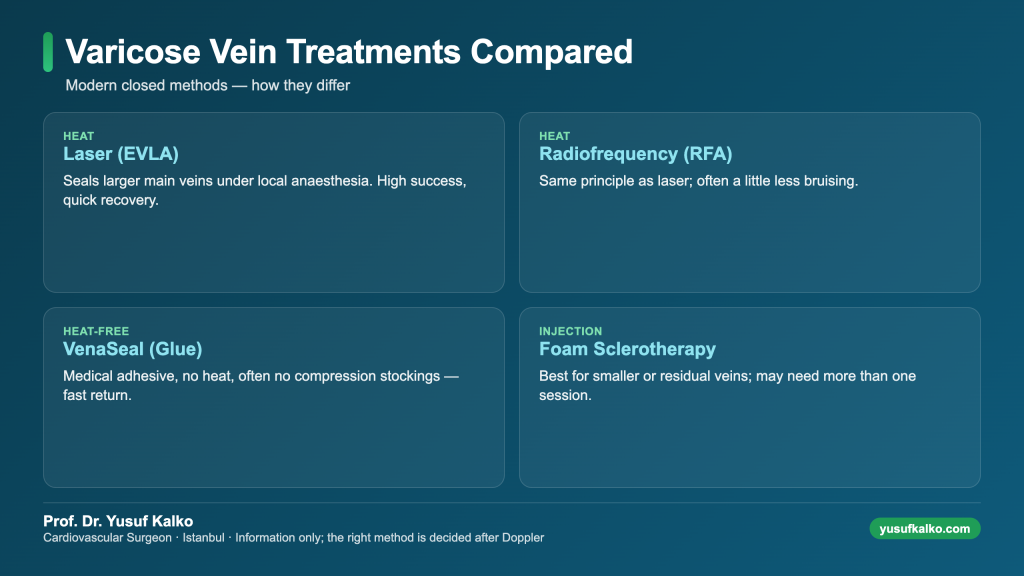
Varicose veins develop when the one-way valves in the leg veins weaken, allowing blood to pool (venous insufficiency). Modern treatment closes the faulty vein from the inside; healthy veins then take over circulation. Here is how the main methods compare:
| Method | How it works | Anaesthesia | Best suited for |
|---|---|---|---|
| Laser (EVLA) | Heat seals the vein | Local (tumescent) | Larger truncal (main) veins |
| Radiofrequency (RFA) | Heat seals the vein | Local (tumescent) | Similar to laser; often less bruising |
| VenaSeal (glue) | Medical adhesive, no heat | Local, minimal | Heat-free option, fast return |
| Foam sclerotherapy | Foam medicine injection | None / minimal | Smaller or residual veins |
Endovenous Laser Ablation (EVLA)
A thin laser fibre is passed into the faulty vein under ultrasound guidance and local anaesthesia; laser energy heats and seals the vein, which the body gradually absorbs. EVLA has a high closure success rate and is well suited to larger main (truncal) veins. Most patients walk immediately and return to daily activities quickly. Mild bruising or tightness along the vein for a few days is normal. See laser varicose vein treatment for details.
Radiofrequency Ablation (RFA)
RFA works on the same principle as laser but delivers radiofrequency heat through a catheter. Results are comparable to EVLA, and some patients experience slightly less bruising or discomfort. It is also performed under local anaesthesia as a closed procedure and is a good option for larger veins.
VenaSeal (Vein Glue)
VenaSeal closes the vein with a medical adhesive instead of heat. Because there is no thermal energy, tumescent anaesthesia around the vein is not required and compression stockings may not be needed afterwards, allowing a very fast return to normal life. It is a good heat-free option for suitable veins.
Foam Sclerotherapy
A foamed medicine is injected to irritate and close smaller veins, branches or residual veins after ablation. It is quick and needle-based, often used together with laser/RFA or for spider and smaller veins. More than one session may be needed.
Which Treatment Is Right for You?
There is no single “best” method — the right one depends on your anatomy. Key factors your surgeon considers:
- Vein size and location — large truncal veins usually suit laser/RFA; small veins suit foam.
- Degree of reflux seen on Doppler ultrasound.
- Heat-free preference or avoiding compression stockings — VenaSeal.
- Cosmetic vs symptomatic goals and how many veins are involved.
- Sometimes methods are combined (e.g. laser for the main vein plus foam for branches).
What About Traditional Surgery (Stripping)?
Open surgery (vein stripping) was once standard but today is reserved for selected cases, because closed methods offer less pain, no large incisions and a faster recovery for most patients. Your surgeon will advise if surgery is genuinely the better option for your veins.
When Leg Swelling Is an Emergency
⚠️ Sudden, painful swelling in one leg, often with warmth is not ordinary varicose disease — it can signal a deep vein thrombosis (DVT, a blood clot). Do not wait; seek medical care promptly.
For International Patients (Istanbul)
Many patients travel to Turkey for vascular care with an experienced cardiovascular surgeon. A typical journey looks like this:
- Remote consultation: share your history and any reports via WhatsApp for a preliminary opinion.
- On arrival: examination and colour Doppler ultrasound to map the veins.
- Treatment: most closed procedures are completed under local anaesthesia, walk-in and walk-out.
- Short stay & follow-up: brief recovery, aftercare advice and guidance on when it is safe to fly.
Prof. Dr. Yusuf Kalko, Cardiovascular Surgeon in Istanbul (Beylikdüzü), plans each case individually after Doppler assessment. You can reach the clinic through the contact page.
Frequently Asked Questions
Which varicose vein treatment is the best?
There is no single best method for everyone. Laser and radiofrequency are excellent for larger main veins, VenaSeal is a good heat-free option, and foam sclerotherapy suits smaller veins. The best choice for you is decided after examination and Doppler ultrasound.
Are these treatments painful?
They are performed under local anaesthesia, so they are generally comfortable. Mild bruising or soreness for a few days is normal, especially after heat-based methods.
How long is the recovery?
Most patients walk immediately and return to daily activities within a day or two. Strenuous exercise and long travel may be limited briefly, as advised by your surgeon.
Can varicose veins come back after treatment?
Treatment closes the current faulty vein with a high success rate, but new varicose veins can develop over time. Staying active, using compression as advised and attending follow-up reduce this risk.
When can I fly after varicose vein treatment?
Many international patients travel within a few days, but timing depends on your case. Because long, immobile flights raise the risk of clots, follow your surgeon’s advice on flight timing and on wearing compression stockings during travel.
Do I need general anaesthesia?
Usually not. Modern closed methods are done under local anaesthesia. This is one reason recovery is faster than with traditional surgery.
Is VenaSeal better than laser?
Not necessarily — they suit different situations. VenaSeal avoids heat and often compression stockings, while laser/RFA are very effective for larger veins. Suitability is decided individually.
How do I start from abroad?
You can send your history and any medical reports via WhatsApp for a preliminary opinion, then plan an in-person examination and Doppler ultrasound on arrival in Istanbul.
