
Most varicose veins no longer need open surgery. The faulty vein is closed from the inside through a puncture the size of a needle prick, under local anaesthesia, and you walk out the same day. These techniques are grouped together as endovenous or "closed" treatments, and the practical question is no longer whether to avoid surgery but which closed method suits your anatomy.
In short: laser (EVLA), radiofrequency, vein glue and foam sclerotherapy all close a refluxing vein without stripping it. The real dividing line is thermal versus non-thermal: heat-based methods need anaesthetic fluid around the vein, heat-free ones do not. The method is chosen after a colour Doppler ultrasound maps which vein is leaking and where.
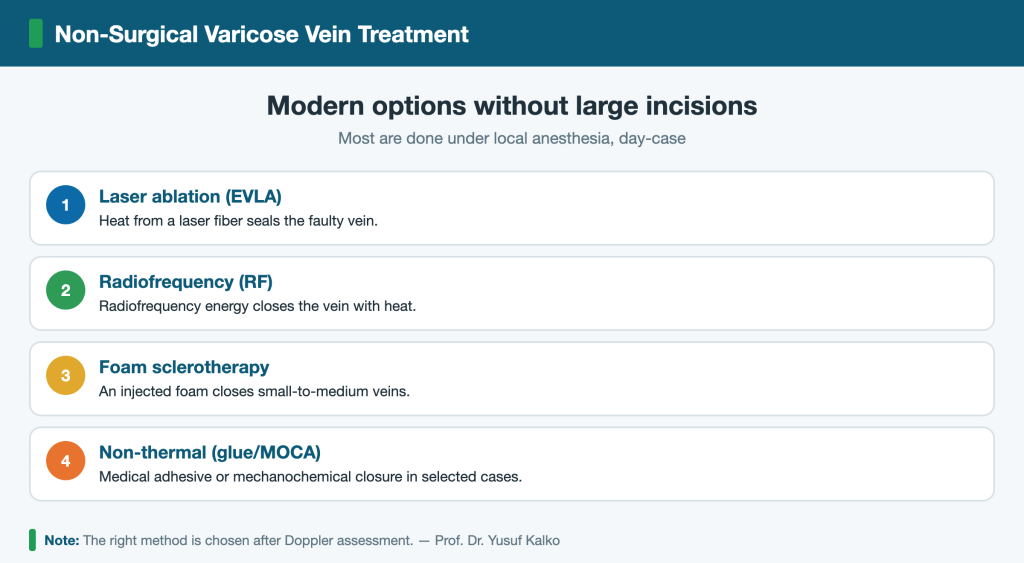
What "non-surgical" means here
It does not mean nothing is done to the vein — it means the vein is treated from within rather than removed through incisions. Instead of the groin incision and stripping used in classical surgery, a catheter or a fine needle is introduced into the vein under ultrasound guidance and the vein is sealed along its length. The body then absorbs the closed vein over the following months, and the blood reroutes through healthy deep veins, which is where most of it was travelling in the first place.
The consequences are what patients notice: local rather than general anaesthesia, no hospital stay, walking immediately, and a return to ordinary activity in days rather than weeks.
Thermal or non-thermal: the real dividing line
Thermal methods (laser and radiofrequency)
Endovenous laser and radiofrequency both work by heating the vein wall from inside until it contracts and seals. Because heat is involved, a dilute anaesthetic solution is injected around the vein along its length — tumescent anaesthesia. That fluid does two jobs: it numbs the area and it forms a protective layer between the hot catheter and the surrounding nerves and skin. It also means several small injections along the leg during the procedure.
Non-thermal methods (glue, mechanochemical, foam)
Heat-free techniques avoid tumescent anaesthesia altogether, which usually means fewer injections and less bruising. Vein glue seals the vein with a medical adhesive delivered through a catheter. Mechanochemical closure combines a rotating wire with a sclerosant. Foam sclerotherapy uses a foamed solution injected directly, and is particularly useful for tributaries and residual veins rather than as the main treatment of a large trunk.
| Method | How it closes the vein | Anaesthesia needed | Typically matched to |
|---|---|---|---|
| Laser (EVLA) | Heat from a laser fibre seals the wall | Local plus tumescent along the vein | Larger refluxing trunk veins |
| Radiofrequency (RFA) | Controlled heat in segments | Local plus tumescent along the vein | Similar to laser; often less post-procedure bruising |
| Vein glue (VenaSeal) | Medical adhesive bonds the walls | Local at the entry point only | Patients who want to avoid tumescent injections and rapid return to activity |
| Mechanochemical (MOCA) | Rotating wire plus sclerosant | Local at the entry point only | Veins close to the skin or near nerves, where heat is less desirable |
| Foam sclerotherapy | Foamed solution irritates and closes the vein | Usually none | Tributaries, recurrent segments and smaller veins |
How the day goes
- Ultrasound mapping. The leg is scanned standing, and the refluxing vein and its tributaries are marked on the skin.
- Local anaesthetic at the entry point; a needle puncture gives access to the vein, with no incision.
- The catheter is positioned under ultrasound, and its tip is checked before anything is delivered.
- The vein is closed along its length as the catheter is withdrawn. For thermal methods, tumescent fluid is placed first.
- Tributaries are addressed in the same sitting where appropriate — by foam or by tiny phlebectomy punctures.
- Compression is applied and you walk. Walking straight afterwards is encouraged; most people go home within the hour.
Who is suitable — and who is not
The usual candidate has symptomatic varicose veins with reflux demonstrated on ultrasound: aching, heaviness, swelling by the end of the day, night cramps, itching along a vein, or skin changes around the ankle. Treatment is also considered after a bleed from a varicosity or an episode of superficial phlebitis.
Not everyone is a candidate for every method, and some situations need a different plan altogether:
- Active deep vein thrombosis — treatment is deferred and the clot managed first.
- Significant peripheral artery disease — the compression used afterwards may not be safe, so the arterial circulation is assessed before deciding.
- Pregnancy — treatment is normally postponed; many pregnancy-related veins improve afterwards, and compression is used in the meantime.
- Known allergy to the adhesive or sclerosant — rules out that particular method, not the others.
- Very tortuous veins lying immediately under the skin — a catheter cannot be passed reliably; these are better handled by tiny phlebectomy punctures.
- Veins with no demonstrable reflux — if the ultrasound is normal, the symptoms are coming from elsewhere and treating the vein will not relieve them.
What to expect afterwards
Compression stockings are worn for a period set at the time, and walking daily is part of the treatment rather than a restriction on it. Most people return to desk work within a day or two and to fuller activity within a week or so, though heavy lifting and intense training are usually paused briefly.
- Bruising and tightness along the treated vein is common, particularly after thermal methods, and settles over a few weeks.
- A firm, tender cord where the vein used to be is expected — it is the closed vein, not a complication, and it softens as it is absorbed.
- Pulling or tugging when you straighten the leg in the first weeks is normal as the vein contracts.
- Numb patches of skin can occur if a small sensory nerve is irritated; these usually recover.
- Flights and long journeys are generally deferred for a short period after treatment and then taken with compression, hydration and regular walking.
Seek urgent medical care after any vein procedure if you develop calf pain with swelling and warmth, sudden shortness of breath or chest pain — these may indicate a clot in the deep veins or the lungs. Spreading redness with fever, or a wound that discharges, needs prompt review for infection. These events are uncommon, but they are time-sensitive, so do not wait for a routine appointment.
How it compares with open surgery
| Endovenous (closed) treatment | Open surgery (stripping) | |
|---|---|---|
| Anaesthesia | Local, with or without tumescent | Usually general or spinal |
| Access | Needle puncture | Incisions, including the groin |
| Hospital stay | Day case, walking out | Often an overnight stay |
| Return to routine | Days | Typically one to several weeks |
| Bruising and scarring | Limited | More pronounced |
| Still has a role | Most refluxing trunk veins | Selected anatomy where a catheter cannot be used |
Why veins can still come back
No technique removes the underlying tendency for valves to leak. Recurrence after a technically good closure usually has one of three explanations: a tributary that was not treated at the time and later enlarges, reflux developing in a different vein that was healthy at the first assessment, or new small vessels growing across the treated area. This is why follow-up matters — a scan at review picks up a developing tributary while it is still a small job, and why a periodic vascular assessment is worthwhile if you have a strong family history. The background condition, chronic venous insufficiency, is managed over years rather than cured in an afternoon.
Why Choose Turkey (Istanbul)?
- Over 30 years of experience in cardiovascular and vascular surgery with Prof. Dr. Yusuf Kalko.
- Modern minimally invasive and hybrid techniques.
- English- and Arabic-speaking support for international patients.
- Easy access to Istanbul from the Gulf, Europe and beyond.
- Remote assessment before travel, then treatment and appointment planning.
How to Start From Abroad (Remote Consultation)
You can send your medical reports and scan images via WhatsApp for an initial assessment before traveling. We then plan your treatment and appointment in Istanbul, Turkey, and support international patients at every step.
To find the right non-surgical option for your veins in Istanbul (Beylikdüzü) and plan suitable treatment, contact us on WhatsApp.
Related Pages
Among the closed methods, the one that uses no heat at all is VenaSeal adhesive closure.
Frequently Asked Questions
Are closed treatments as effective as open surgery?
For the great majority of refluxing trunk veins, yes — endovenous closure achieves comparable results with markedly less downtime, and it is the approach recommended first in modern guidance. Open surgery remains the better answer for a minority of anatomies, and that decision is made on the ultrasound rather than in advance.
Is the procedure painful?
It is carried out under local anaesthesia and most people describe pressure rather than pain. With heat-based methods you feel the small tumescent injections along the leg; with glue or mechanochemical closure there is usually only the single entry point. Ordinary pain relief is enough afterwards for most.
Can I go home the same day?
Yes. These are day-case procedures: you walk immediately afterwards and most people leave within the hour. Someone to drive you home is sensible, but an overnight stay is not normally needed.
How soon can I fly afterwards?
Flying is normally deferred for a short period after treatment, then undertaken with compression stockings, good hydration and regular walking in the cabin. The exact interval depends on the method used and the length of the flight, so confirm it before booking.
Which method will I have?
That is decided after the leg is scanned. Vein diameter, how deep it runs, how straight it is and how close it lies to nerves and skin all influence the choice, and it is common to combine a trunk closure with foam or small phlebectomies for the tributaries in one sitting.
Do I have to wear compression stockings?
Compression is a standard part of recovery and influences bruising, comfort and the final result. The duration is set individually. If you have arterial circulation problems in the legs, this is assessed first, because compression is not safe for everyone.
Will the veins come back?
The treated vein does not reopen in most cases, but new varicose veins can develop over the years because the underlying tendency remains. Untreated tributaries are the most common reason for an early recurrence, which is why follow-up scanning is useful.
Do you treat international patients?
Yes. International and Gulf patients are seen in Istanbul, with English- and Arabic-speaking support, and an initial remote assessment can be made from your reports and scan images before you travel.