
In short: The carotid arteries in the neck carry blood to the brain. When they narrow from atherosclerosis (carotid artery disease), a piece of plaque or clot can travel to the brain and cause a stroke or a mini-stroke (TIA). Carotid disease is often silent until this happens, so knowing the warning signs matters. Remember F.A.S.T. — Face drooping, Arm weakness, Speech difficulty, Time to call emergency services. Diagnosis is quick and painless (carotid Doppler ultrasound); treatment ranges from medication and risk control to surgery (endarterectomy) or stenting for significant narrowing. Because the same process affects the heart and legs, stroke prevention overlaps with overall vascular health. This guide is written for international patients considering assessment in Istanbul, Turkey.
What Is Carotid Artery Disease?
You have two carotid arteries, one on each side of the neck, supplying most of the blood to the brain. Over years, fatty plaque (atherosclerosis) can build up and narrow them. The danger is not usually the narrowing itself but the risk that plaque debris or a clot breaks off and blocks a brain artery — causing a stroke. Carotid disease frequently causes no symptoms at all until that moment, which is why screening in people with risk factors is valuable.
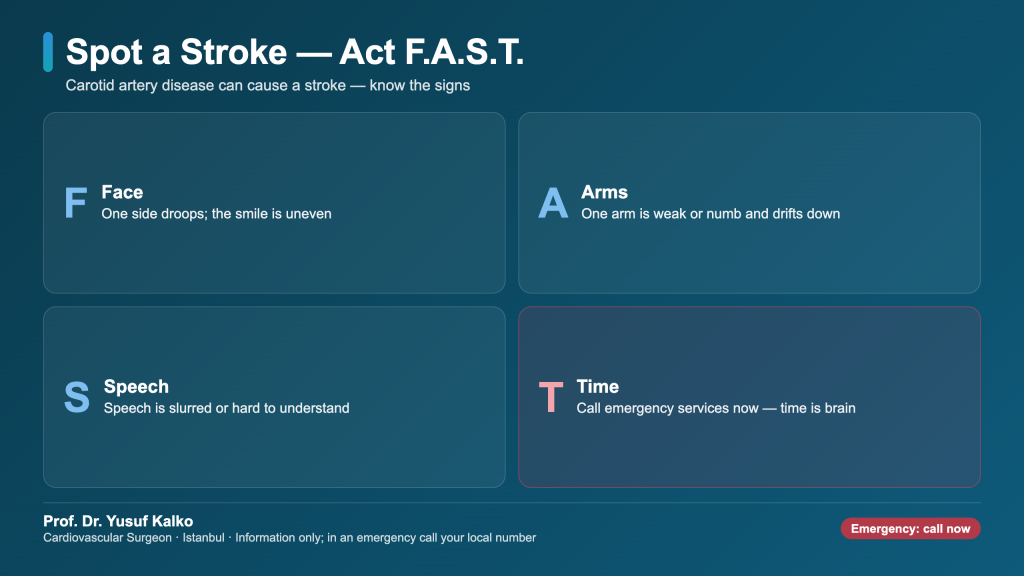
Warning Signs: Learn F.A.S.T.
A stroke or mini-stroke (transient ischaemic attack, TIA) is a medical emergency. The F.A.S.T. test helps you act quickly:
| Letter | Sign |
|---|---|
| F — Face | One side of the face droops; the smile is uneven |
| A — Arms | One arm is weak or numb and drifts down |
| S — Speech | Speech is slurred or hard to understand |
| T — Time | Call emergency services immediately — time is brain |
This Is an Emergency
⚠️ Any sudden face drooping, arm weakness, speech difficulty, or sudden loss of vision or balance may be a stroke. Call your local emergency number immediately — do not wait to see if it improves. Fast treatment saves brain tissue and lives.
How It Is Diagnosed
The main test is a carotid Doppler ultrasound — painless, radiation-free and quick — which shows how narrowed the artery is and how blood is flowing. When treatment is being planned, CT or MR angiography gives a detailed map. Your doctor may also examine the heart and other arteries, since atherosclerosis rarely affects only one area.
Treatment: Medication, Surgery or Stent
Treatment depends on how narrow the artery is and whether it has caused symptoms:
| Approach | When it is used |
|---|---|
| Medication & risk control | Milder narrowing; antiplatelet, statin, blood-pressure and diabetes control |
| Carotid endarterectomy (surgery) | Significant narrowing; the plaque is removed to restore flow |
| Carotid stenting | Selected patients; the artery is opened with a stent via catheter |
Reducing Your Stroke Risk
- Stop smoking — one of the most powerful steps,
- Control blood pressure, cholesterol and diabetes,
- Take prescribed medication (such as antiplatelet and statin) as advised,
- Stay active, eat a heart-healthy diet and keep a healthy weight,
- Treat an irregular heartbeat (atrial fibrillation) if present, as it also raises stroke risk.
It Is Connected: Heart and Legs Too
Carotid narrowing is one expression of body-wide atherosclerosis. Someone with carotid disease is more likely to have narrowing in the heart’s arteries and in the leg arteries. That is why the same measures that protect your brain also protect your heart and legs — and why unexplained leg pain when walking or chest symptoms should be evaluated together.
For International Patients (Istanbul)
International patients are assessed by an experienced cardiovascular surgeon in Istanbul along a clear pathway:
- Remote consultation: share your history and any scans via WhatsApp for a preliminary opinion.
- On arrival: examination and carotid Doppler ultrasound; angiography if a procedure is planned.
- Treatment: risk control, and — where indicated — carotid endarterectomy or stenting.
- Follow-up: medication guidance, monitoring and advice on safe travel.
Prof. Dr. Yusuf Kalko, Cardiovascular Surgeon in Istanbul (Beylikdüzü), assesses the carotid arteries as part of your overall vascular health. Reach the clinic via the contact page.
Frequently Asked Questions
Does carotid artery disease cause symptoms?
Often it is silent until it causes a stroke or mini-stroke (TIA). Some people are found to have it during a check-up or when a doctor hears a sound (bruit) over the neck artery. This is why screening matters in people with risk factors.
What is a mini-stroke (TIA)?
A TIA has the same symptoms as a stroke but they resolve, often within minutes to an hour. It is a serious warning sign of a possible future stroke and must be evaluated urgently, even if you feel completely normal afterwards.
How is carotid narrowing measured?
A carotid Doppler ultrasound estimates the degree of narrowing and blood flow. If treatment is considered, CT or MR angiography provides a detailed picture.
Surgery or stent — which is better?
Both open the artery and lower stroke risk in suitable patients. Endarterectomy removes the plaque surgically; stenting opens the artery via a catheter. The right choice depends on your anatomy, symptoms and overall health, and is decided individually.
Can carotid disease be treated without surgery?
Milder narrowing is often managed with medication and risk-factor control (stopping smoking, treating cholesterol, blood pressure and diabetes). Surgery or stenting is considered for significant narrowing, especially after symptoms.
Who should be screened?
People with several risk factors — older age, smoking, high blood pressure, high cholesterol, diabetes, or known artery disease elsewhere — may benefit from a carotid ultrasound. Your doctor can advise.
Is a stroke really an emergency if it goes away?
Yes. Even if symptoms pass (a TIA), it is a red flag that needs urgent assessment. Prompt treatment greatly reduces the chance of a major stroke.
How do I start an assessment from abroad?
Send your history and any scans via WhatsApp for a preliminary opinion, then plan an in-person examination and carotid Doppler ultrasound on arrival in Istanbul.
