
Most people judge their veins by how the leg looks. That is the least reliable guide there is: prominent veins can sit on a leg with no reflux at all, and a leg with no visible veins can have valves that stopped working years ago. What the symptoms do reveal is a pattern — and the pattern is what this self-assessment is built around.
In short: the hallmark of venous disease is heaviness, aching and ankle swelling that build through the day and ease when the legs are raised. Visible veins are only one sign among several. Two answers carry extra weight: brown staining or eczema above the ankle, and an open sore now or in the past. The test that settles it is a colour Doppler ultrasound performed standing.
Varicose vein self-assessment
Eight questions, under a minute. Everything runs in your browser; nothing you enter is stored or sent anywhere.
The result is a prompt to get assessed, not a stage of disease. Only an ultrasound establishes which vein is leaking — and that is what determines treatment.
What the questions are actually asking about
Leg veins work against gravity. The calf muscles pump blood upward with every step, and one-way valves stop it falling back between steps. When those valves leak, pressure in the lower leg stays high instead of dropping as you walk — a state called ambulatory venous hypertension, and every symptom in the questionnaire follows from it.
That single mechanism explains the timing. Pressure accumulates over hours of standing, so symptoms are worst in the evening; raising the legs removes the gravitational column, so they ease. It also explains why walking helps rather than harms: the calf pump is the part of the system still working. The background condition is chronic venous insufficiency.
The pattern that identifies venous disease
What it feels like
- Heaviness and aching that builds through the day rather than striking suddenly.
- Ankle swelling by evening, often leaving a sock mark, largely gone by morning.
- Night cramps and restless legs.
- Itching or burning along a vein or over the inner ankle.
- Relief on elevation — the most useful single feature.
What it is confused with
Arterial pain comes on while walking and eases on standing still — the opposite relationship to activity, and a different condition entirely, covered under peripheral artery disease. Swelling that involves the toes and does not settle overnight points towards lymphedema. Swelling in both legs equally, unchanged by elevation, raises heart, kidney or liver causes. And a leg that swells over hours with pain and warmth is a different matter again.
The two answers that carry extra weight
Most of the questions describe discomfort. Two describe damage, and they are the reason the tool weights them more heavily.
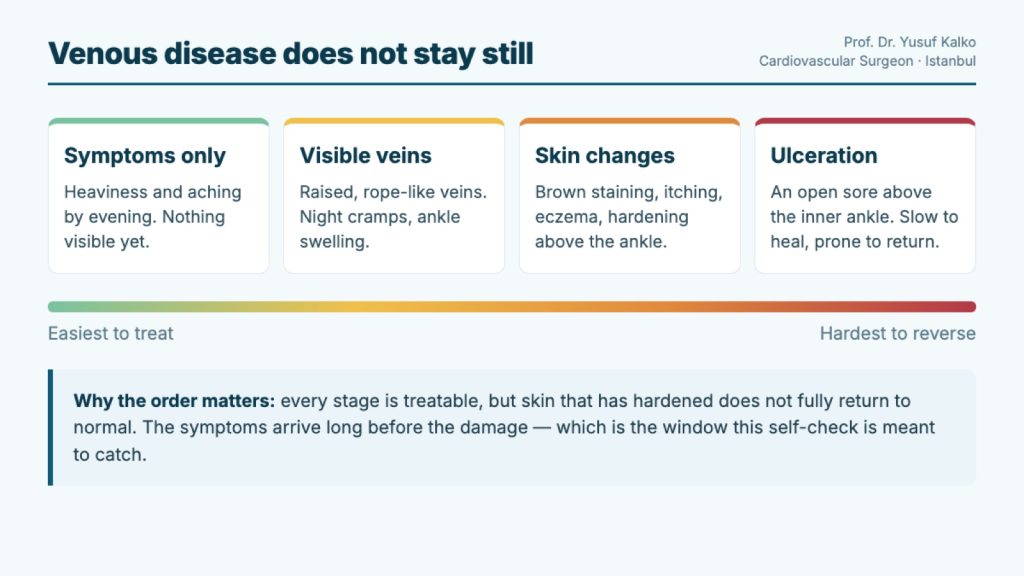
- Brown staining, itching or eczema above the ankle. Iron pigment leaking from the vessels into the skin, with inflammation around it. This is skin under sustained pressure, and it is the stage immediately before ulceration.
- An open sore above the inner ankle, now or healed. Around four in five leg ulcers are venous. They heal with proper compression and they return if the underlying reflux is never treated — which is why both halves are needed, and why current practice favours treating the vein early rather than waiting for the wound to close.
| Stage | What is present | What it usually means |
|---|---|---|
| Symptoms only | Heaviness, aching, evening swelling; nothing visible | Assessment to confirm where symptoms come from; compression and movement |
| Visible veins | Raised, rope-like varicose veins | Treatment considered where symptoms or reflux are present |
| Skin changes | Pigmentation, eczema, hardening above the ankle | Active treatment advised to prevent progression |
| Ulceration | An open sore, or one that healed previously | Compression plus early treatment of the underlying reflux |
Seek same-day medical care if one leg becomes swollen, painful and warm over hours or days — this may be a deep vein thrombosis, and compression is not the answer until it has been excluded. If a varicose vein bleeds, lie down, raise the leg above heart level and press firmly on the point with a clean pad; bleeding from a surface varicosity stops with elevation and pressure, and standing up makes it worse. An ulcer with spreading redness, increasing pain or fever needs prompt review for infection.
What happens at the assessment
- Examination standing, because veins empty when you lie down and the pattern disappears with them.
- Colour Doppler ultrasound — which veins leak, how long the backward flow lasts, where the faulty valve sits, and whether the deep veins are open and healthy.
- A plan built from the map, not from the appearance of the leg. Superficial reflux can be treated; deep reflux is managed differently.
What treatment involves
Compression, walking, elevation and weight management are the foundation at every stage, provided the arterial circulation has been checked first — compression is not safe for every leg. Where the scan shows a superficial vein leaking and symptoms persist, that vein is closed through a needle puncture under local anaesthesia: endovenous laser, radiofrequency, adhesive closure or foam sclerotherapy. The options are compared side by side under non-surgical varicose vein treatment, and the condition as a whole under varicose veins treatment. Fine surface vessels are a separate job, covered under spider veins.
Frequently Asked Questions
Can I have venous disease without visible varicose veins?
Yes, and it is common. Reflux in a deeper trunk vein can produce heaviness, evening swelling and skin changes with nothing prominent on the surface. The reverse also happens — visible veins with no significant reflux — which is why the ultrasound rather than the appearance decides the treatment.
How accurate is this self-assessment?
It is a prompt, not a diagnosis, and it cannot grade your disease. Its value is in the pattern: symptoms that build through the day and ease on elevation point towards the veins, and two answers — skin change and ulceration — point towards disease that should not be left alone.
Is leg swelling always a vein problem?
No. Swelling that involves the toes and does not settle overnight suggests lymphedema. Swelling in both legs equally, unaffected by elevation, raises heart, kidney or liver causes. Sudden swelling of one leg with pain and warmth needs same-day assessment for a clot.
What does brown discolouration above the ankle mean?
It is iron pigment that has leaked from the vessels into the skin under sustained pressure, often with eczema alongside it. It indicates established venous disease and marks the stage before ulceration — which is why it is weighted heavily in the result.
Do compression stockings treat the cause?
They control the pressure and relieve symptoms, and they are the foundation of management, but they do not repair a leaking valve. Where the ultrasound shows a refluxing vein and symptoms persist, closing that vein addresses the cause. Arterial circulation is checked before compression is prescribed, because it is not safe for every leg.
Will treatment stop new varicose veins forming?
Closing the faulty vein removes it from the problem, but the underlying tendency remains, so new veins can develop over the years. Untreated tributaries are the most frequent cause of early recurrence, which is why follow-up scanning is useful.
Is it worth being assessed if the symptoms are mild?
Generally yes, because this is a condition where the early stages are the easy ones. Skin that has hardened does not fully return to normal, and ulcers recur while the pressure problem is untreated — so the aim is to act while the only complaint is heaviness.
Do you see international patients?
Yes. International and Gulf patients are seen in Istanbul with English- and Arabic-speaking support, and an initial remote assessment can be made from your existing reports and scan images before you travel.
References
- NHS — Varicose veins
- MedlinePlus (NIH) — Varicose veins
- Society for Vascular Surgery — Chronic venous insufficiency
- NHS — Venous leg ulcer
Related Pages
- Varicose veins treatment
- Chronic venous insufficiency
- Non-surgical varicose vein treatment
- Spider vein treatment
- Colour Doppler ultrasound
- Lymphedema
← All health tools · All articles in English
This content is for information only and does not replace diagnosis or treatment. Assessment is made by a medical examination.
