
An arrhythmia is a disturbance of the heart’s electrical system rather than of its muscle or its valves: the heart beats too fast, too slowly, or irregularly. Some types carry little risk and need reassurance more than treatment; others raise the risk of stroke silently. Assessment and treatment in Istanbul, Turkey.
In short: the hard part is usually not the treatment but catching the rhythm on a recording. An ECG captures one moment; an episode that happens once a month will not be on it. A normal ECG does not rule an arrhythmia out — it only means that moment was not recorded. The monitor is chosen from how often your episodes happen.
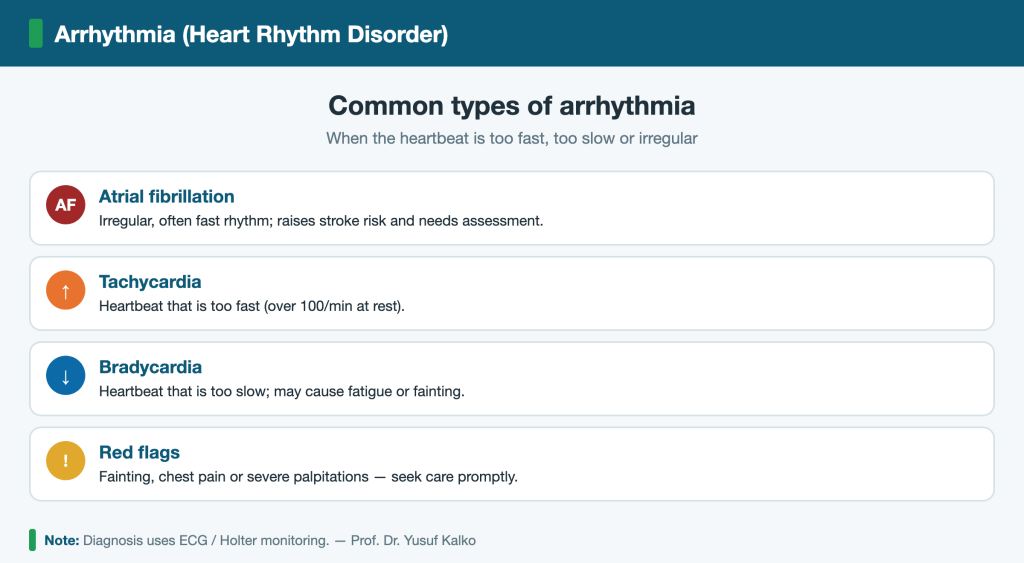
What an arrhythmia is
Each heartbeat begins as an electrical signal that starts at a defined point and travels along a fixed path. Anything that disturbs where the signal starts or how it travels changes the rhythm. This is why an arrhythmia does not necessarily mean a weak heart: it can occur in a structurally normal one, and it can equally be the visible sign of something else — an overactive thyroid, a valve problem, anaemia or untreated sleep apnoea.
Before any of this, there is something you can check yourself. An irregular pulse is often the first and only sign of atrial fibrillation, and it is found by counting for a full minute and paying attention to whether the gaps between beats are even — set out, with an interpreter tool, in what should your pulse rate be.
Common types
- Atrial fibrillation — the commonest: a completely irregular and often fast rhythm whose main danger is stroke rather than the palpitation itself,
- Supraventricular tachycardia — episodes of fast, regular palpitation that start and stop abruptly, often in younger people,
- Bradycardia and conduction block — a rhythm too slow, causing fatigue, dizziness or fainting,
- Ectopic beats — the sensation of a skipped beat or a thud; very common and usually harmless,
- Ventricular arrhythmias — less common and more serious, needing specialist assessment.
Is every palpitation an arrhythmia?
No — and this is a question that can often be narrowed down before any test:
| Points away from a rhythm disorder | Points towards one |
|---|---|
| Palpitation with anxiety or stress, or after coffee or an energy drink | An abrupt start and stop, as though a switch were thrown |
| Palpitation with anaemia, fever or dehydration | A pulse that is completely irregular when you feel it |
| A steady awareness of the heartbeat all day | Discrete episodes with a clear beginning and end |
| Accompanied by symptoms of thyroid overactivity | Accompanied by dizziness, breathlessness or chest discomfort |
| Settles with rest and slow breathing | Starts during exertion, or wakes you from sleep |
Seek emergency care for: fainting or loss of consciousness; palpitation with chest pain or severe breathlessness; palpitation that begins during physical exertion; sudden weakness on one side or slurred speech. Early assessment is also warranted if there is a history of sudden death in the family at a young age.
The real difficulty: catching it
Episodes often end before you reach a clinic, so the ECG comes back entirely normal. That result does not exclude an arrhythmia; it means the moment was not recorded. Which recorder makes sense depends on how often episodes occur:
| How often do episodes happen? | What usually suits |
|---|---|
| Daily or almost daily | ECG plus a Holter recording over one or two days |
| A few times a week | An extended recording over several days |
| About once a week or once a month | A longer-term recorder, or a device you activate yourself when you feel an episode |
| Rarely, with unexplained fainting | Long-term monitoring arranged by a specialist |
The assessment is usually completed with an echocardiogram to look at the heart muscle and valves, and blood tests including thyroid function, electrolytes and a check for anaemia — because treating the cause sometimes ends the arrhythmia without anything further.
What to note before your appointment
- When an episode began and how long it lasted, in minutes if you can,
- How it started and ended — abruptly, or gradually,
- What preceded it: exertion, coffee or an energy drink, a new medicine, little sleep, fever, alcohol,
- What came with it: dizziness, breathlessness, chest discomfort, sweating,
- Your pulse during the episode if you were able to feel it — regular or irregular, and roughly how fast,
- Your medicines and supplements — some supplements contain stimulants that provoke palpitation.
Atrial fibrillation and stroke risk
This type deserves a section of its own, because its main danger is not what you feel. When the upper chambers no longer contract in an organised way, blood can stagnate in them and form a clot that travels to the brain. The decision about anticoagulation is therefore not based on how strongly you feel the palpitation but on risk factors taken together — age, blood pressure, diabetes, heart failure and any previous stroke. A patient who feels nothing may need it; one who feels palpitation daily may not.
A further consequence: some atrial fibrillation is entirely silent and found by chance. That is why, after a stroke, it is looked for even in someone with no palpitation at all — not every stroke originates in the neck arteries. See stroke, carotid artery disease and, for a valve-related cause, rheumatic heart valve disease.
Treatment options
- Treating causes and triggers — thyroid disorder, blood pressure, untreated sleep apnoea, alcohol, caffeine, weight and sleep. This alone improves a substantial share of cases,
- Medication — to control the rate or restore the rhythm, and anticoagulation where atrial fibrillation warrants it,
- Catheter ablation — interrupting or isolating the electrical pathway responsible; an option in several fast rhythms and in selected cases of atrial fibrillation,
- A pacemaker — for slow rhythms and conduction block,
- Other implanted devices in selected high-risk ventricular arrhythmias.
One principle underlies all of it: not every arrhythmia needs treatment. A few ectopic beats in a structurally normal heart may need an explanation and an adjustment of triggers, and nothing more. The options and their timing are decided within the heart team once the recording and the assessment are complete.
Why Choose Turkey (Istanbul)?
- Over 30 years of experience in cardiovascular and vascular surgery with Prof. Dr. Yusuf Kalko.
- Modern minimally invasive and hybrid techniques.
- English- and Arabic-speaking support for international patients.
- Easy access to Istanbul from the Gulf, Europe and beyond.
- Remote assessment before travel, then treatment and appointment planning.
How to Start From Abroad (Remote Consultation)
You can send your medical reports and scan images via WhatsApp for an initial assessment before traveling. We then plan your treatment and appointment in Istanbul, Turkey, and support international patients at every step.
To evaluate your heart rhythm in Istanbul (Beylikdüzü) and plan suitable treatment, contact us on WhatsApp.
Related Pages
Frequently Asked Questions
Is arrhythmia dangerous?
Some are harmless, but others — like atrial fibrillation — raise the risk of stroke, so assessment is important.
Can arrhythmia be cured?
Many arrhythmias are well controlled with medication, ablation or a pacemaker depending on the type.
Does atrial fibrillation cause stroke?
AF increases stroke risk, which is why blood-thinning treatment is often advised after assessment.
Do you treat international patients?
Yes. We welcome international and Gulf patients in Turkey (Istanbul), with English- and Arabic-speaking support throughout assessment and treatment.
How can I book an appointment from abroad?
Via WhatsApp: send your inquiry and medical reports, and we will arrange your appointment and explain the steps before and after arriving in Istanbul.
Can I have a consultation before traveling?
Yes. An initial remote assessment can be made based on your reports and scans before you come to Turkey.