
TAVI — transcatheter aortic valve implantation, also written TAVR — replaces a narrowed aortic valve without opening the chest. A replacement valve mounted on a collapsible frame is threaded up through an artery, usually in the groin, and expanded inside the diseased valve, which is pushed aside and takes on the role of a scaffold. The heart keeps beating throughout and no heart-lung machine is used.
In short: TAVI treats severe aortic stenosis, a narrowing of the valve between the heart and the body's main artery. The decision between TAVI and open valve surgery is made by a heart team from imaging, age, other illnesses and valve anatomy — not by preference alone. The moment that changes everything is the appearance of symptoms: breathlessness, chest tightness or blackouts in someone with known aortic stenosis means the assessment should not be postponed.
The problem: severe aortic stenosis
The aortic valve is the door between the main pumping chamber and the rest of the body. Over decades it can stiffen and calcify until the opening is a fraction of its original area. The heart compensates for years by thickening its muscle and pushing harder, which is why the condition is silent for so long — and why it is frequently found as a murmur during an examination for something else.
The three symptoms that change the picture
- Breathlessness on exertion, often attributed to age or being out of condition.
- Chest tightness with activity, because a thickened muscle needs more blood than the coronary arteries can supply.
- Blackouts or near-blackouts on exertion, when the narrowed valve cannot increase output to meet demand.
Aortic stenosis is well tolerated until it is not. Once these symptoms appear, the outlook changes markedly and valve replacement becomes the treatment that alters it — medication relieves symptoms but does not open the valve. This is the single most useful thing to understand about the condition: the question is not whether the valve is severely narrowed on a scan, but whether it has begun to cause symptoms.
Who is considered for TAVI
TAVI began as the option for people considered too high-risk for open surgery. It is now used across a much wider range, and the assessment weighs several things together:
- Surgical risk and frailty — other illnesses, lung and kidney function, previous heart surgery, general reserve.
- Age — relevant chiefly because it interacts with how long the valve needs to last.
- Valve and root anatomy on CT — the size and shape of the valve ring, how the calcium is distributed, where the coronary arteries open.
- Access route — whether the arteries in the groin are wide enough and clear enough to carry the delivery system.
- Other cardiac problems — significant coronary disease or another diseased valve may favour open surgery, which can address them in the same operation.
The heart team decision
The decision is made by a heart team — cardiac surgeon, interventional cardiologist, imaging specialist and anaesthetist — rather than by one clinician. Where the arteries in the leg will not accommodate the delivery system, alternative access routes exist through the chest wall or a neck artery; the leg route remains the usual one.
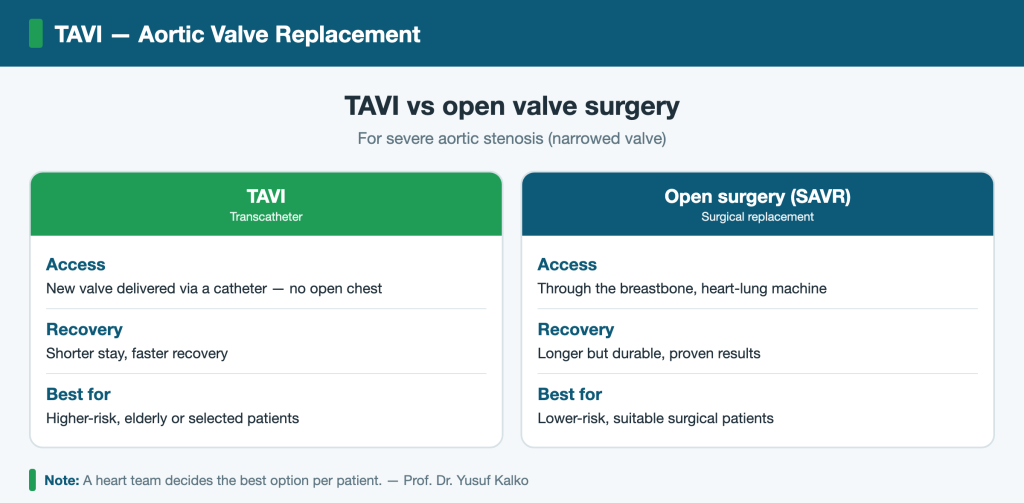
TAVI compared with open valve surgery
| TAVI | Open surgery (SAVR) | |
|---|---|---|
| Chest opened | No | Yes — breastbone or a smaller incision |
| Heart-lung machine | Not used | Used; the heart is stopped |
| Anaesthesia | Often sedation with local anaesthesia | General |
| Hospital stay | Usually a few days | Usually around a week |
| Return to routine | Typically one to two weeks | Typically six to twelve weeks |
| Valve type | Tissue valve only | Tissue or mechanical valve |
| Lifelong blood thinner | Not required for the valve itself | Required with a mechanical valve |
| Pacemaker afterwards | More frequently needed | Less frequently needed |
| Other problems fixed at once | No | Yes — bypass grafts or a second valve |
How the procedure works
- A CT scan maps the valve, the aortic root and the access arteries, and the valve size is chosen from it.
- Access is gained through the femoral artery in the groin, usually under sedation with local anaesthesia rather than a general anaesthetic.
- A wire is passed across the narrowed valve and the delivery system is advanced over it under X-ray and echo guidance.
- The new valve is positioned within the old one and deployed, either by expanding a balloon or by allowing a self-expanding frame to open.
- Function is checked immediately — valve movement, any leak around the frame, and the heart's conduction.
- The puncture is closed. Most people are sitting up within hours and walking the same day or the next.
Recovery
The first two weeks
Because the chest is not opened and the heart is not stopped, recovery is markedly quicker than after open surgery. A hospital stay of a few days is typical, with walking beginning almost immediately and ordinary activity resuming within one to two weeks. Breathlessness frequently improves within days, since the obstruction the heart was working against has gone. Cardiac rehabilitation is still worthwhile — the heart muscle has been working against resistance for years and takes time to remodel.
Risks specific to TAVI
- Conduction disturbance needing a permanent pacemaker. The valve sits directly against the heart's electrical pathway, and pressure on it can block conduction. This is the most characteristic complication of TAVI and the rhythm is monitored closely afterwards; see arrhythmia and rhythm disorders.
- Leak around the valve frame (paravalvular leak), where the new valve does not seal perfectly against calcified tissue. Modern valves have reduced this, and a significant leak can usually be addressed during the same procedure.
- Stroke, from debris dislodged as the valve is crossed and expanded.
- Vascular access complications — injury, bleeding or blockage of the artery used for delivery, which is why those vessels are assessed carefully beforehand.
- Contrast and kidney function, planned for in advance where function is reduced.
Seek emergency care if, after a TAVI, you have blackouts, fainting or a very slow pulse, which may indicate a conduction problem; sudden breathlessness or chest pain; signs of a stroke — facial droop, arm weakness, slurred speech, sudden loss of balance or vision; or bleeding, severe pain or a rapidly enlarging swelling at the groin. Anyone with known severe aortic stenosis who faints, develops chest pain or becomes breathless at rest should be assessed urgently rather than waiting for a scheduled appointment.
The valve afterwards: durability and follow-up
How long the valve lasts
TAVI valves are made from tissue, and tissue valves wear out eventually — which is why expected lifespan relative to valve durability is part of the original decision. Long-term data continue to accumulate, and a valve that degenerates can in many cases be treated by implanting a second valve inside the first, which is one reason the original implant position is planned with that future in mind.
What follow-up involves
Follow-up involves periodic echocardiography to watch valve function, attention to rhythm, and continuing care of the rest of the cardiovascular system — blood pressure, cholesterol and diabetes. Good dental health matters more than people expect: any prosthetic valve carries a risk of infection seeded from elsewhere in the body, so dental care and prompt treatment of infections are part of protecting it. Where rheumatic disease was the original cause, see rheumatic heart valve disease; aortic stenosis also frequently coexists with disease elsewhere in the arterial tree, including aortic aneurysm.
Why Choose Turkey (Istanbul)?
- Over 30 years of experience in cardiovascular and vascular surgery with Prof. Dr. Yusuf Kalko.
- Modern minimally invasive and hybrid techniques.
- English- and Arabic-speaking support for international patients.
- Easy access to Istanbul from the Gulf, Europe and beyond.
- Remote assessment before travel, then treatment and appointment planning.
How to Start From Abroad (Remote Consultation)
You can send your medical reports and scan images via WhatsApp for an initial assessment before traveling. We then plan your treatment and appointment in Istanbul, Turkey, and support international patients at every step.
To evaluate your aortic valve and treatment options in Istanbul (Beylikdüzü) and plan suitable treatment, contact us on WhatsApp.
Related Pages
Frequently Asked Questions
Is TAVI major surgery?
It is a major procedure but not open surgery. The chest is not opened, the heart is not stopped and no heart-lung machine is used; access is through an artery in the groin, usually under sedation rather than general anaesthesia. Most people walk the same day or the next.
Who is suitable for TAVI?
People with severe, symptomatic aortic stenosis in whom the heart team judges the catheter route appropriate. Surgical risk, frailty, age, the anatomy of the valve and root on CT, and whether the leg arteries can carry the delivery system all feed into that judgement.
How long is recovery after TAVI?
A hospital stay of a few days is usual, with walking almost immediately and ordinary activity in roughly one to two weeks — compared with six to twelve weeks after open surgery. Breathlessness often improves within days.
Why might I need a pacemaker afterwards?
The new valve sits against the heart’s electrical conduction pathway, and pressure on it can interrupt conduction. This is the most characteristic complication of TAVI, which is why heart rhythm is monitored closely in the days afterwards and why a pacemaker is sometimes required.
How long does a TAVI valve last?
It is a tissue valve, so it does not last indefinitely. Durability data continue to mature, and expected lifespan relative to valve life is weighed when the approach is chosen. A degenerated valve can often be treated by placing a second valve inside the first.
Will I need to take a blood thinner for life?
Not because of the valve itself, which is one difference from a mechanical valve implanted at open surgery. Antiplatelet or anticoagulant medicine may still be prescribed for other reasons, such as atrial fibrillation, and that is decided individually.
What happens if severe aortic stenosis is left untreated once symptoms start?
The outlook changes markedly once breathlessness, chest tightness or blackouts appear, and medication relieves symptoms without opening the valve. That is why the onset of symptoms in known aortic stenosis is treated as the point at which assessment should not be delayed.
Do you treat international patients?
Yes. International and Gulf patients are seen in Istanbul with English- and Arabic-speaking support, and an initial remote assessment can be made from your reports and scan images before you travel.