
Your pulse is the number of times the heart beats in a minute, and it is the simplest cardiac sign you can check at home. But the number is often not the point: the same 88 beats can be entirely normal in one person and the first trace of a rhythm disorder that has gone unnoticed for years in another. This page gives the normal ranges — and then asks the question that gets far less attention: is your pulse regular?
In brief: a resting pulse in adults is usually 60-100 bpm; in people who train regularly it can sit under 50, and that is often a good sign. Count for a full 60 seconds — counting 15 seconds and multiplying by four hides an irregular rhythm. If fainting, chest pain or breathlessness come with it, the number stops mattering and it needs emergency assessment.
Pulse Interpreter
Enter your age, your resting pulse and — most importantly — whether the rhythm was regular. The tool runs in your browser and nothing you type is stored or sent anywhere.
Does any of this come with it?
These symptoms change the assessment whatever the number is. If any is ticked the tool stops calculating and points you straight to emergency care, because waiting is not the right move in that picture.About you
Both change the answer. Rate-slowing medicines are an expected cause of a low pulse, and the target-heart-rate method does not apply to people taking them. In regular endurance athletes a resting pulse down to around 40 is ordinary.How to take your pulse properly
Step by step
- Sit and rest for five minutes. Avoid coffee, tea, energy drinks and smoking for the half hour before.
- Use your wrist. With the palm facing up, place your index and middle finger in the groove on the thumb side, between the bone and the tendon. Do not use your thumb — it has a pulse of its own and will mislead you.
- Count for a full 60 seconds. This is the most important detail on the page: counting 15 seconds and multiplying by four gives the rate but hides the rhythm.
- Watch the gaps, not only the speed. Do the beats arrive evenly spaced, or do some crowd together and leave a gap behind them?
- Repeat on different days. One reading is a snapshot; you only learn your own normal from several.
Why a full minute, and why the wrist?
Most sources suggest counting for 15 seconds and multiplying by four. That gives the rate accurately enough, but it conceals the rhythm. Irregularity often comes intermittently: it may not fall inside a 15-second window at all. Counting the whole minute lets you see both the number and whether the intervals are even.
The neck is also an option, but pressing too firmly there can slow the pulse or cause light-headedness in some people. For measuring at home, the wrist is preferred.
Normal pulse ranges by age
| Age | Resting pulse (bpm) |
|---|---|
| Newborn (0-1 month) | 70 – 190 |
| 1-11 months | 80 – 160 |
| 1-2 years | 80 – 130 |
| 3-4 years | 80 – 120 |
| 5-6 years | 75 – 115 |
| 7-9 years | 70 – 110 |
| 10 years and over, adults | 60 – 100 |
| Well-trained endurance athletes | 40 – 60 |
One detail worth knowing: women typically have a resting pulse a few beats higher than men. The reason is that the heart is on average slightly smaller and moves a little less blood with each beat — the rate compensates.
The real question: regular or irregular?
The most valuable part of taking your pulse is the part most pages give the least space to. In the United Kingdom the national health service has run a know your pulse campaign for years, and its purpose is not to measure fitness: it is to catch atrial fibrillation.
Why does that matter so much? Atrial fibrillation is the most common heart rhythm disorder, and its most dangerous feature is that it is often felt by nobody. UK figures put it at roughly 1.4 million people, a factor in around one in five strokes, with an estimated half a million who do not know they have it. In the fibrillating upper chamber blood can pool and form a clot; if that clot travels to the brain, the result is a stroke.
How do you tell regular from irregular?
How do you tell them apart? A regular pulse is like a runner clearing hurdles at an even pace — tap… tap… tap. In an irregular pulse several beats crowd together, then an unexpected gap follows; if you try to tap along with your foot, you cannot. While you count your 60 seconds, focus not only on how many beats there are but on whether the gaps between them are equal.
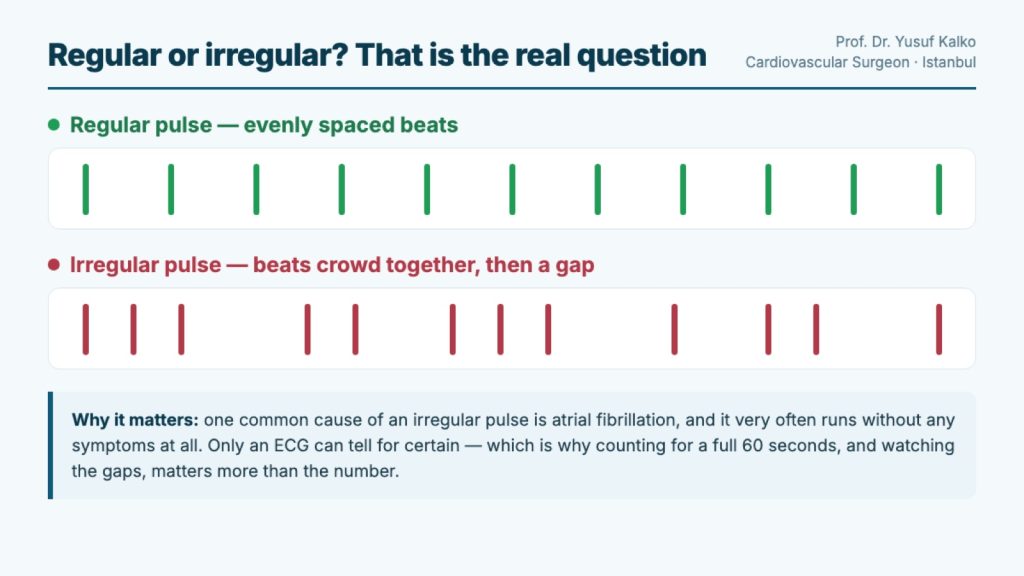
If you do notice irregularity there is no need to panic, but there is no sense in postponing it either. Irregularity felt with the fingers is not a diagnosis; the test that settles it is an ECG, with a Holter monitor if it comes in episodes. For the stroke side of the subject, see stroke: causes, FAST symptoms and prevention and carotid artery disease and stroke prevention; for the rhythm side, arrhythmia treatment.
Things that raise the pulse temporarily
When you see a high reading, the first thing to ask is what the conditions were. The following genuinely raise the pulse, and the number returns to normal once they pass:
- Caffeine — coffee, tea, energy drinks; the effect can last for hours,
- Fever — every degree of temperature rise speeds the pulse noticeably,
- Fluid loss — thirst, diarrhoea, heavy sweating,
- Excitement, anxiety and stress — this can happen during the blood-pressure reading itself,
- Anaemia — the heart compensates for blood that carries less oxygen by circulating it faster,
- An overactive thyroid,
- Some medicines and supplements — decongestants, asthma inhalers, weight-loss and "energy" products,
- Pregnancy — blood volume rises, so the resting pulse normally rises with it,
- Smoking and alcohol.
This is why a resting pulse that stays high is not a diagnosis on its own; it is a finding whose cause should be looked for. Measuring over several days at different times and writing the readings down gives your doctor something useful to work with.
Is a low pulse always bad?
Athlete’s bradycardia: low but healthy
No — and this is one of the more commonly misunderstood points. A resting pulse under 60 is called bradycardia, but in people who train regularly for endurance the heart muscle is stronger, moves more blood with each beat and does the same work with fewer beats. In well-trained athletes a resting pulse down in the 40s is an expected finding and a marker of efficiency.
What comes with the low pulse?
What matters is what accompanies it. Tiredness, a drop in exercise capacity, dizziness, visual greying or fainting can mean the heart is not maintaining enough output, and that should be assessed. Rate-slowing medicines such as beta blockers are also a common cause of a low pulse — and their dose should never be changed on your own.
Target heart rate for exercise — and the limits of the formula
The heart-rate range aimed for during exercise is worked out from an estimated maximum. The method most people have heard of is the 220 – age formula, with moderate exercise targeted at roughly 50 to 70 of that maximum and vigorous exercise at 70 to 85.
Three limits of the formula
| Limit | What it means in practice |
|---|---|
| It is an estimate, not a measurement | Individual variation around these formulas is roughly 11 beats either way, so your real maximum may sit well above or below the calculated figure. |
| It was derived mainly from men | The classic formula fits women less well; the revised 208 – 0.7 x age version is generally the closer one. |
| Rate-slowing medicines break it | Beta blockers lower the pulse both at rest and on exertion, so the calculated zone may be unreachable however hard you work. |
If you take a beta blocker, the target-heart-rate method does not apply to you. These drugs lower the pulse at rest and during exercise alike; you may never reach the calculated zone however hard you push, and reading that as "I am not working hard enough" and pushing further is the wrong conclusion. International guidance recommends a perceived exertion scale instead, or a target set individually from an exercise test. Discuss your exercise intensity with your doctor.
A pulse you cannot feel in the foot is a different question
Everything above is about the pulse at the wrist, which reports on the heart. A pulse that is weak or absent at the ankle or the top of the foot reports on something else entirely: the arteries supplying the leg. That is a vascular finding, not a rhythm one, and it belongs to peripheral artery disease.
The two are worth separating because the symptoms are completely different. A rhythm problem shows up as palpitations, dizziness or an irregular beat. An arterial problem in the leg shows up as cramping calf pain that starts after a set walking distance and stops when you stand still, as cold or pale feet, or as a wound that will not heal. Where the leg arteries are the question, the test is not an ECG but a colour Doppler ultrasound. If you have risk factors and no symptoms yet, a vascular check-up is the structured way to look.
How reliable are smartwatch and wristband readings?
Where the optical sensor goes wrong
Devices that measure optically at the wrist are usually acceptably close at rest and in a regular rhythm. Their reliability falls in these situations:
- During exercise that moves the arm (weights, racket sports, cycling),
- When the band is loose or sits over the wrist bone,
- In the cold, when the vessels of the hand and fingers constrict,
- Over tattoos, on darker skin tones and with some skin conditions, where the optical reading is harder,
- When the rhythm is irregular — which is the critical part.
The ECG feature on a watch is a different thing
The ECG feature built into some devices is not the same as optical pulse measurement, and it can give a more meaningful clue about irregularity. Even so, no wearable makes a diagnosis: if your device has flagged an irregular rhythm, that is not a result but a reason to see a doctor. Take the device’s recording with you; it makes the assessment easier.
Whatever the number is, these are emergencies: fainting or feeling about to faint; chest pain or pressure in the chest; breathlessness even at rest; a very fast palpitation that starts suddenly and does not settle; facial drooping, slurred speech or weakness down one side. Do not spend time measuring — call your local emergency number: 112 in Türkiye and across the EU, 999 in the UK, 911 in the US.
Frequently Asked Questions
What should my pulse rate be?
In adults at rest it is usually between 60 and 100 beats per minute. In people who train regularly for endurance, 40 to 60 is common and expected. What matters is not a single reading but knowing your own normal and noticing when it shifts clearly away from it.
Can I count for 15 seconds and multiply by four?
It gives the rate roughly, but it is not what this page recommends. Fifteen seconds is too short a window to judge whether the intervals between beats are equal, and it can miss an irregular rhythm completely. Count for 60 seconds.
My pulse is irregular — what should I do?
There is no need to panic, but do not put it off. Irregularity felt with the fingers is not a diagnosis; an ECG settles it, and a Holter monitor may be needed if the irregularity comes and goes. One common cause is atrial fibrillation, which frequently causes no symptoms at all. If fainting, chest pain or breathlessness come with it, it needs emergency assessment.
My resting pulse is always over 100 — is that dangerous?
It is not a diagnosis on its own, but the cause should be looked for. An overactive thyroid, anaemia, fever, dehydration, anxiety, caffeine and certain medicines are common reasons. Measure over several days at different times and write the readings down; arriving with that record is far more useful than arriving with one reading.
My pulse is around 50 — is something wrong?
If you train regularly and feel well, usually not; it can simply mean the heart is working efficiently. If you take a rate-slowing medicine, that is an expected effect of the drug. It does need assessing if it comes with tiredness, dizziness, a drop in exercise capacity or fainting.
Are blood pressure and pulse the same thing?
No. The pulse is how many times the heart beats per minute; blood pressure is the force the blood exerts on the vessel wall. One can be high while the other is normal, and they can also move together. They answer different questions and are measured differently.
My smartwatch flagged an irregular rhythm — is it serious?
Treat the alert as a prompt rather than a result: devices do not diagnose and they can flag falsely. Ignoring it is not right either, because silent rhythm disorders are exactly what this picks up. Take the device’s recording with you and see a doctor.
Related Articles

References
- British Heart Foundation — Your heart rate
- Mayo Clinic — What is a normal resting heart rate?
- NHS — Atrial fibrillation: check your pulse
- Harvard Health — Target heart rate on a beta blocker
Related Pages
- Arrhythmia (heart rhythm disorder) treatment
- Stroke: causes, FAST symptoms and prevention
- Carotid artery disease and stroke prevention
- Peripheral artery disease (leg)
- Colour Doppler ultrasound: what it shows
- Vascular check-up: what is actually looked at
- Vascular diseases overview
← All health tools · All articles in English
This content is for information only and does not replace diagnosis or treatment. Assessment is made by a medical examination.
