
Spider veins — telangiectasias — are the fine red, blue or purple webs that show through the skin on the thighs, calves, ankles and sometimes the face. They are extremely common, they are usually harmless, and they respond well to treatment. The part that is worth getting right is the order: a spider vein fed by a deeper faulty vein will keep coming back until that vein is dealt with.
In short: spider veins are mostly a cosmetic concern and are treated with sclerotherapy or surface laser, usually over more than one session. Before treating them, an ultrasound should rule out reflux in the deeper veins — otherwise they recur. Fading takes weeks, not days, and some darkening of the treated line in between is expected.
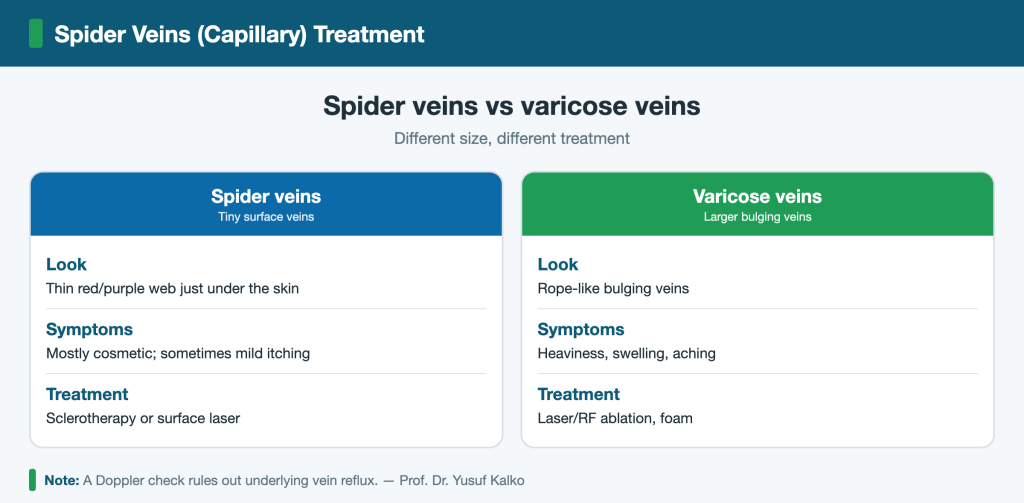
What are spider veins?
Spider veins are very small dilated vessels sitting just beneath the skin surface. They carry no meaningful share of the circulation, which is why closing them causes no harm: the blood simply returns through neighbouring healthy veins. They are classified by calibre, and the calibre is what decides how they are treated.
Spider, reticular and varicose veins
| Vessel | Approximate calibre | How it looks | Usual approach |
|---|---|---|---|
| Telangiectasia (spider vein) | under 1 mm | Fine red or purple web, flat against the skin | Micro-injection sclerotherapy or surface laser |
| Reticular vein | 1 – 3 mm | Flat bluish-green line, often feeding a spider cluster | Sclerotherapy, treated before the spider veins themselves |
| Varicose vein | over 3 mm | Raised, rope-like, bulges on standing | Endovenous closure, glue or phlebectomy |
This matters in practice because a cluster of spider veins very often has a reticular "feeder" running into it. Injecting only the visible web, while the feeder is left open, is the single most common reason people are disappointed a few months later.
Why they appear
There is rarely one cause. The contributing factors that come up most often are:
- Family history — the strongest single predictor; vein wall and valve structure is inherited.
- Hormonal influence — pregnancy, oestrogen-containing contraception and hormone therapy all increase vein wall distensibility, which is why spider veins frequently appear or worsen during pregnancy.
- Prolonged standing or sitting — occupations that keep you upright and still raise the pressure in the leg veins for hours at a time.
- Weight gain and ageing — more load on the venous system, and vein walls that lose elasticity.
- Local trauma — a knock, a surgical scar or repeated pressure can leave a cluster behind.
- Sun exposure — the main driver for facial spider veins, often alongside rosacea or long-term topical steroid use.
- Underlying vein reflux — sometimes the web is not the problem but the signpost.
Why reflux must be ruled out first
This is the part that separates a lasting result from a frustrating one. In a healthy leg, one-way valves keep blood moving upward. When those valves leak, blood falls back down and the pressure it creates has to go somewhere — often into the small surface vessels, which dilate and become visible.
If that is what is happening, treating the surface alone is treating the symptom. The web will fade, then return, because the pressure feeding it was never addressed. A colour Doppler ultrasound answers the question in a few minutes and changes the plan when it is positive: the refluxing vein is closed first, and the spider veins are treated afterwards — by which time some of them have already improved on their own.
An ultrasound is particularly worth doing when the spider veins are extensive, when they sit around the inner ankle, or when they come with heaviness, aching, night cramps, ankle swelling or visible varicose veins. Those features point towards chronic venous insufficiency rather than a purely cosmetic finding.
Sclerotherapy: what actually happens
The session
- The leg is examined standing, so the veins are filled and the feeding pattern is visible; the map is often marked on the skin.
- A very fine needle is used to inject a sclerosant into the vein — a solution that irritates the inner lining so that the vessel walls stick together and the vein is gradually absorbed by the body.
- Several injections are made along each cluster; a typical session treats one region and lasts around twenty to forty minutes.
- Compression stockings are applied before you stand up, and you walk out immediately.
What you feel
Most people describe a brief stinging or a hot, cramping sensation that lasts seconds as each injection goes in. No anaesthetic is normally needed. The legs can ache mildly for a day or two afterwards, and walking helps rather than hinders.
Afterwards: compression and sun
Compression is usually advised for a period after treatment and is one of the things that most affects the final appearance. Walking daily is encouraged; long periods of standing still, very hot baths, saunas and intense leg workouts are generally avoided for the first days. Sun protection on the treated area matters, because freshly treated skin pigments more readily.
Surface laser: when it is the better choice
Transdermal laser delivers energy through the skin, which is absorbed by the haemoglobin inside the vessel and collapses it. It does not involve a needle, and that makes it the more sensible option in three situations: very fine vessels that will not take a needle reliably, facial spider veins where injection is less suitable, and people who genuinely cannot tolerate needles.
For most leg spider veins, however, sclerotherapy remains the workhorse — it handles reticular feeders in the same session, which laser cannot. Skin tone is also part of the decision: in darker skin, laser carries a higher risk of leaving a lighter or darker mark, so settings and method are chosen accordingly.
| Method | How it works | Most suitable for | Points to weigh |
|---|---|---|---|
| Sclerotherapy (micro-injection) | A solution closes the vein from inside | Most leg spider and reticular veins | Needles; can treat the feeding vein in the same sitting |
| Surface (transdermal) laser | Energy through the skin collapses the vessel | Very fine vessels, facial veins, needle-sensitive patients | No needles; cannot reach deeper feeders; skin tone affects settings |
| Treating the feeding vein first | Endovenous closure of a refluxing vein | Where ultrasound shows reflux | Done before surface work, otherwise recurrence is likely |
What is normal afterwards — and what is not
Knowing what the first weeks look like prevents a great deal of unnecessary worry, because the treated area usually looks worse before it looks better.
| What you may see | Is it expected? | What is usually done |
|---|---|---|
| Red, raised, slightly itchy lines over the treated veins for a few days | Expected | Nothing; it settles on its own |
| Bruising around the injection points | Expected | Settles over one to two weeks |
| Brown staining along the treated vein (hyperpigmentation) | Common | Usually fades over several months; sun protection helps |
| A crop of very fine new red vessels nearby (matting) | Occasional | Often settles; sometimes treated at a later session |
| A firm, tender lump in a treated vein (trapped blood) | Occasional | Released with a needle at a follow-up visit; speeds up fading |
| Calf pain with swelling, warmth and breathlessness | Not expected | Urgent assessment — see the warning below |
Seek urgent medical care if, after any vein treatment, you develop calf pain with swelling and warmth, chest pain or sudden shortness of breath — these can indicate a clot in the deep veins or the lungs. Also seek prompt review for a spreading skin rash or breathing difficulty after an injection, which may signal an allergic reaction, or for an area of skin that breaks down or ulcerates at an injection site.
That last warning is worth repeating in context: a calf that becomes swollen, warm and painful over hours or days after any vein treatment should be assessed the same day, because the symptoms overlap with those of a deep vein thrombosis.
Realistic expectations
- Treated veins fade gradually over weeks, not immediately — the body has to reabsorb them.
- More than one session is usual; the number depends on how extensive the area is, not on how well the first session worked.
- Clearance is typically substantial but rarely absolute; a realistic aim is marked improvement rather than skin with no visible vessels at all.
- Treatment deals with the veins you have. It does not change the underlying tendency, so new spider veins can appear over the years — which is normal and treatable, not a failure of the first treatment.
Reducing the chance of new ones
Nothing prevents spider veins entirely in someone predisposed to them, but a few things genuinely reduce the load on the leg veins: moving regularly rather than standing or sitting still for long stretches, using the calf muscles (walking, cycling, ankle exercises at a desk), keeping weight in a healthy range, elevating the legs at the end of a long day, and wearing graduated compression if your work keeps you upright. For facial veins, daily sun protection is the single most useful measure.
Why Choose Turkey (Istanbul)?
- Over 30 years of experience in cardiovascular and vascular surgery with Prof. Dr. Yusuf Kalko.
- Modern minimally invasive and hybrid techniques.
- English- and Arabic-speaking support for international patients.
- Easy access to Istanbul from the Gulf, Europe and beyond.
- Remote assessment before travel, then treatment and appointment planning.
How to Start From Abroad (Remote Consultation)
You can send your medical reports and scan images via WhatsApp for an initial assessment before traveling. We then plan your treatment and appointment in Istanbul, Turkey, and support international patients at every step.
To assess your veins and plan treatment in Istanbul (Beylikdüzü) and plan suitable treatment, contact us on WhatsApp.
Related Pages
Frequently Asked Questions
Are spider veins dangerous?
Usually not — on their own they are a cosmetic finding and carry no risk. They matter when they are a sign of something deeper: extensive spider veins, or ones accompanied by heaviness, aching, ankle swelling or visible varicose veins, can point to reflux in the larger veins, which is worth assessing with an ultrasound.
How many sessions will I need?
Often two or more, spaced a few weeks apart. The number depends mainly on how large an area is being treated and how dense the clusters are. Each session is judged once the previous one has had time to fade, which is why they are not scheduled back to back.
Will they disappear completely?
Many fade substantially and some clear entirely, but complete clearance of every vessel is not a realistic promise. Results also vary between people for reasons that are not fully predictable in advance.
Will they come back?
The veins that are treated and absorbed do not return. New ones can appear over time, because the underlying tendency remains — and that is far more likely if a refluxing feeding vein was never identified and treated.
Is the treatment painful?
Discomfort is usually minimal: a brief stinging or hot sensation with each injection, or a sensation like a rubber band flick with laser. Anaesthetic is not normally required and you walk out straight afterwards.
Why has the treated area gone brown?
This is hyperpigmentation — iron pigment left behind as the vein is reabsorbed. It is common, it is not a complication, and it usually fades over a period of months. Protecting the area from sun while it settles makes a noticeable difference.
Can spider veins be treated during pregnancy?
Treatment is normally deferred until after pregnancy and breastfeeding. Many spider veins that appear during pregnancy improve on their own in the months afterwards, so assessing them later avoids treating veins that would have settled anyway. Compression stockings are the usual measure in the meantime.
Do you treat international patients?
Yes. International and Gulf patients are seen in Istanbul, with English- and Arabic-speaking support, and an initial remote assessment can be made from your reports and scan images before you travel.